~5 minute read
By Stephen Rohrer, CES™ (Wealth Manager) at Life Financial Group
Originally shared on the Life in the Markets podcast — 11/2/2026
Subscribe on Apple Podcasts or Spotify.
*Note: you will get the most out of this market update by watching the video above*
Last week, investors moved money out of big tech and into value stocks because the biggest companies in the world are spending faster than they earn. Meanwhile, American households are doing the same thing: the personal savings rate just hit its lowest level since 2008. Here’s what happened in the markets, and what it teaches us about stewarding both our investments and our household finances.
Weekly Market Recap: A Mixed Week With a Dramatic Friday
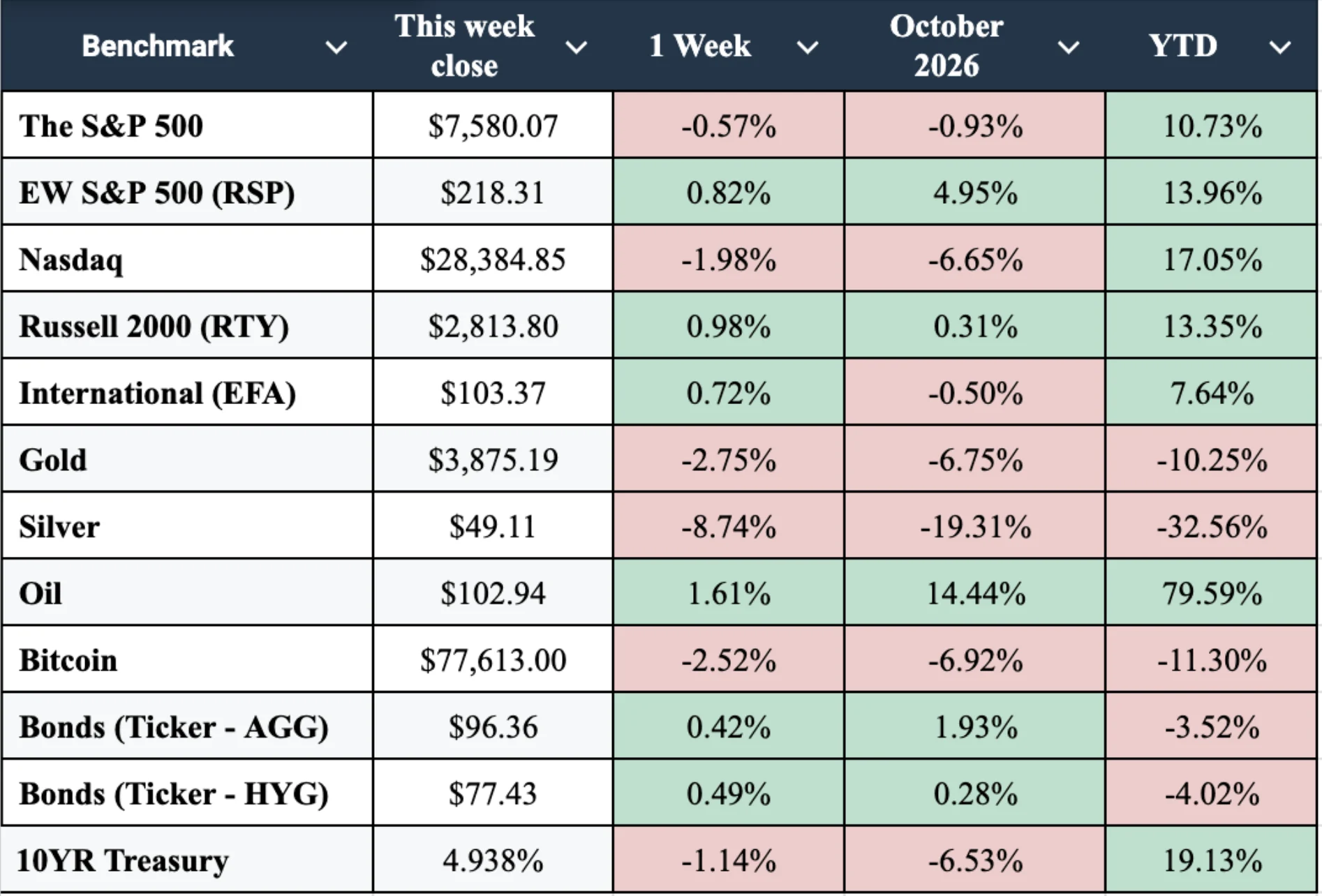
The market finished mixed, with Friday’s trading drama setting the tone.
When a few mega-cap companies struggle, the cap-weighted index feels it most. The average stock did just fine.
The Fed and bonds. The Fed held rates steady, and the market still expects a hike before year-end. The 10-year Treasury fell over a point, while the rest of the bond market rose about half a point.
Winners and losers. Value names like Walmart, Coca-Cola, ExxonMobil, and Chevron did well. Intel had its worst day since 1974, falling about 29% on Friday after earnings and revenue missed badly. The company cited weaker PC demand and a major factory accident in Israel.
Big Tech’s AI Spending: Investors Want to See the Return
Amazon and Alphabet also fell after reporting AI buildout spending so large that it is producing negative or very weak cash flow.
Demand for AI is real and growing. I hear constantly from friends and family whose companies are using it to become more productive. But investors are now saying, “That’s all fine and well, but the numbers must make sense.” After pouring vast sums into AI infrastructure, shareholders expect a return.
The Economy: Strong Growth, Confident Consumers
- GDP beat expectations at 3.4% annualized versus 3.2% expected.
- Inflation rose, as expected, likely confirming the Fed’s path toward a rate hike later this year.
- Jobs stayed strong. The four-week average of initial jobless claims dropped to 197,000, and continuing claims are about 200,000 below the 2025 trend.
- Consumer confidence jumped. The Conference Board’s October index rose to 91.7 from 84.2, nearly 10 points above expectations.
- Spending backed it up. Visa, Mastercard, and American Express reported steady-to-strong spending, and September new home sales reached 676,000 versus 651,000 expected.
The Personal Savings Rate Hits Its Lowest Level Since 2008
Whatever Americans are spending on, their savings are shrinking. The personal savings rate fell to 3.8% from 4%, the lowest since July 2008. The biggest companies in the world and the average household are on a similar path: spending is outpacing earning.
Is Spending More Than You Earn Always Bad?
Not necessarily. Ask any farmer who puts a vast amount of money into the ground each spring and waits months for the harvest. Businesses do the same when they invest in buildings, machinery, or infrastructure for growth. Households have these seasons too: the car needs repairs, the 12-year-old breaks an arm, the transmission dies, and savings get tapped.
But this cannot continue indefinitely, especially when the spending goes toward consumption rather than investment.
A Lesson From Rockefeller: Invest Boldly, Trim Ruthlessly
Reading a biography of John D. Rockefeller, I was struck by a constant tension: long seasons of acquiring nearly every company he could, paired with ruthless cost cutting to improve cash flow. Elon Musk shows a similar pattern today.
Seasons will come when something big must be fixed or a real opportunity appears. If we haven’t trimmed the unnecessary, we won’t be able to weather the storm or seize the opportunity. So ask yourself:
- What areas can I trim?
- What is extraneous or unnecessary?
- How can I be smarter with the resources God has given me to manage?
- Is this purchase really worth it?
Something can be worth it even if it isn’t an investment. The return may come as happiness, health, relationships, or Kingdom impact. But the return must be there.
What This Means for Investors: Look for Disciplined Leadership
Look for companies whose leaders know the difference between wise investment and reckless spending. That’s one reason companies with decades of consistent dividend payments stand out. Sustaining a dividend that long requires real discipline with cash flow.
Looking Ahead: Midterms and More Big Tech Earnings
Midterm elections (Tuesday, November 3). Midterms often bring more gridlock and fewer policy changes. Markets like predictability, which is one reason they have historically tended to do well in the 12 months after a midterm.
Apple and Palantir earnings. It will be interesting to see how they balance earnings against spending.
What Is Truly Worth It
“The kingdom of heaven is like treasure hidden in a field, which a man found and covered up. Then in his joy he goes and sells all that he has and buys that field. Again, the kingdom of heaven is like a merchant in search of fine pearls, who, on finding one pearl of great value, went and sold all that he had and bought it.” (Matthew 13:44-46, ESV)
As we evaluate what is truly worth an expenditure, remember that nothing compares with our Savior and the salvation we have in Him. Anything that puts our treasure and our heart with Him is worth it. Have an excellent week, and God bless.
Have questions about what this means for your own plan? Reach out to our team, we’re glad to talk it through.
Stay Connected
Have questions or topics you’d like us to cover in a future episode? Email us at contact@thelifegroup.org with “Life in the Markets” in the subject line.
✅ Like, comment, and subscribe on YouTube
🎧 Listen to the audio podcast wherever you get your shows
📘 Pick up a copy of The Good Steward to grow in your financial discipleship

Disclaimer: The topics discussed here are for informational purposes only and do not constitute specific investment advice. Investing involves risks, including potential loss of principal. Past performance does not guarantee future results. Securities and advisory services offered through Geneos Wealth Management, member FINRA/SIPC.