~5 minute read
By Steve Virkler (Wealth Manager) at Life Financial Group
Originally shared on the Life in the Markets podcast — 8/31/2026
Subscribe on Apple Podcasts or Spotify.
*Note: you will get the most out of this market update by watching the video above*
Where the Markets Stand
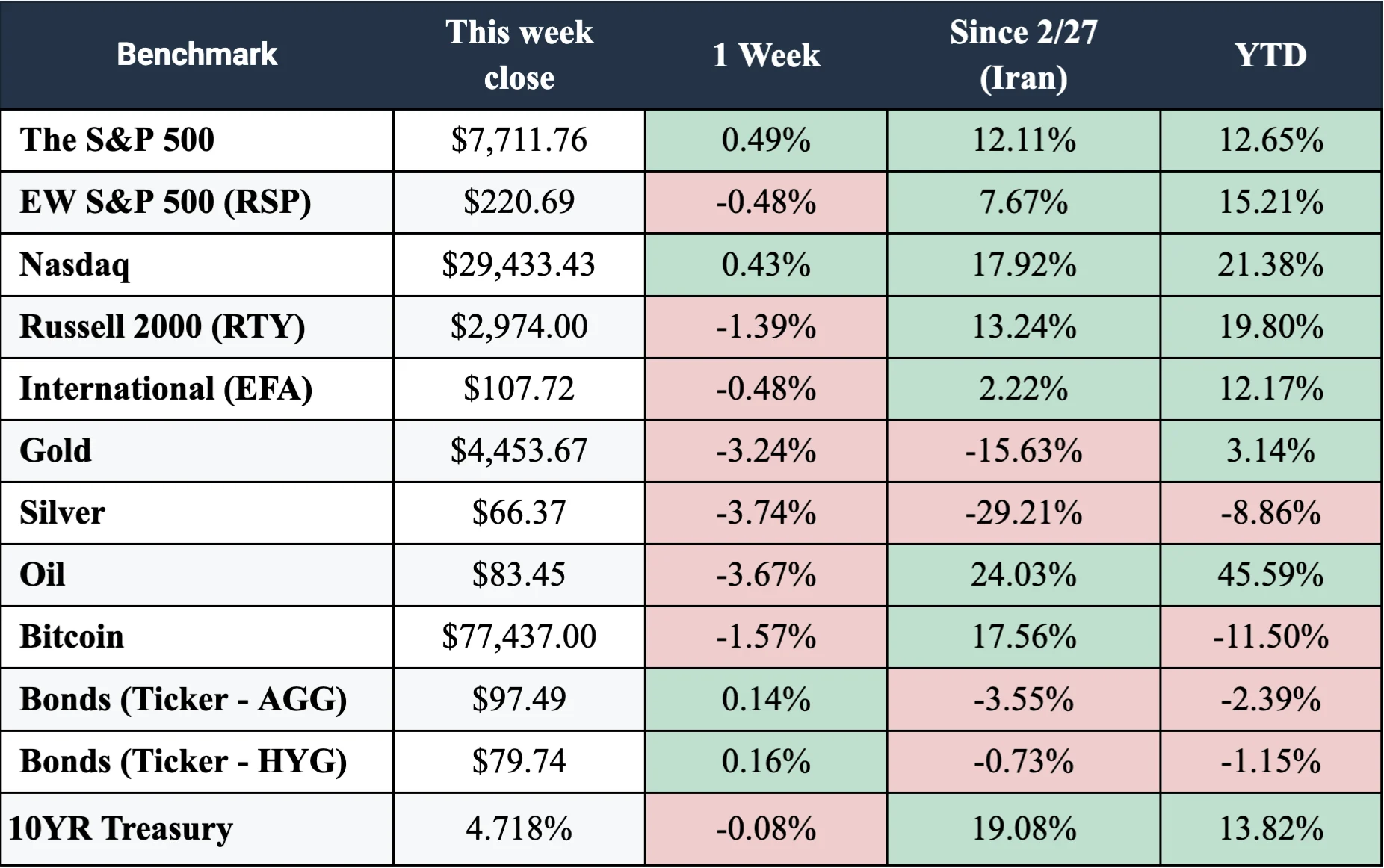
The S&P 500 squeaked out a gain for the week, up 0.49%. Year to date, it is up 12.65%. The Nasdaq also posted a positive number, rising 0.43% and clawing back the prior week’s 1.4% decline, which had snapped a three-week win streak. Most other benchmarks finished the week lower.
For the S&P 500 and the Nasdaq, this was the fourth gain in five weeks, and that is despite stocks closing lower on Friday to finish out the week. Something happened Friday that did move the markets, and we will get to that shortly.
Stocks were broadly higher thanks to strong returns in the technology sector, following several better-than-expected earnings reports.
Nvidia Was the Story of the Week
We cannot talk about last week without talking about Nvidia. Shares jumped 8.7% after the chip company’s revenue forecast met lofty investor expectations. It was the single biggest catalyst of the week.
Revenue came in at $96.2 billion, up 106% year over year, nearly double where the company stood a year ago. Nvidia outperformed its peers, reaffirmed the strength of the AI boom, fueled gains across technology stocks, and bolstered the view that the tech rally still has room to run. The companies at the center of the AI boom continue to deliver impressive results and growth.
Other technology success stories came from a more traditional corner of the industry. Salesforce and CrowdStrike both reported results that calmed worries about advanced AI tools disrupting traditional software. Those reports narrowed the gap somewhat between standard software stocks and semiconductors, which have been seen as the primary beneficiaries of the AI boom.
Oil prices did not change much last week and held steady, with crude closing near $83 a barrel. Oil has still done well overall year to date, and that has been a major story in 2026. More on oil in a few moments.
What Last Week’s Economic Data Told Us
We received several economic updates last week that gave us a window into some key metrics.
GDP
The second estimate of Q2 2026 GDP came in unrevised at 1.5% annualized growth, down from Q1’s 2.1% pace. Consumer spending, exports, and investment drove the gain, partly offset by lower government spending and higher imports.
Employment
Jobless claims fell to 203,000 versus an estimate of 208,000. Continuing claims, the total number of people receiving benefits, fell to 1.778 million from 1.796 million.
The labor market is still healthy, and these numbers suggest layoffs remain limited. The unemployment rate stands at 4.1%, slightly below the Fed’s longer-run projection of 4.2%, which many consider its estimate of full employment. Meeting those numbers allows the Fed to focus more squarely on inflation.
Speaking of inflation.
Inflation
The July PCE price index, or Personal Consumption Expenditures, rose 0.2% month over month. Year-over-year rates held at 3.7% headline and 3.3% core, which excludes volatile food and energy and is the Fed’s preferred inflation gauge. Both figures were unchanged from June, and both remain well above the Fed’s 2% target.
Consumer Sentiment
The Conference Board’s Consumer Confidence Index declined for a second consecutive month, falling to 89.4 and coming in below the consensus forecast of 90.2.
The details show an interesting divergence. Consumers’ assessment of current business and labor conditions actually rose, but the short-term outlook fell by 5.8 points. In other words, consumers are becoming more cautious and more worried about prices and the job market than hard spending data currently shows. The Conference Board explicitly cited rising references to “war/conflict” and “food/groceries” in consumer comments.
Will these concerns begin to affect consumer spending? That is the key question that has been on economists’ minds all year as these worries persist.
Retail Earnings
Retail earnings were a mixed bag, but generally positive. Interestingly, a number of prominent retailers that posted earnings gains cited tariff refunds as a major factor. That list includes Best Buy, Dollar General, Dollar Tree, Ulta Beauty, Williams-Sonoma, Burlington, and Abercrombie.
How are retailers using those refunds? Walmart is lowering prices for shoppers. Target is boosting corporate margins. Home Depot and Lowe’s are offsetting operating costs.
On the negative side, multiple retailers pointed to lower-income consumers who are financially strapped and more sensitive to high gas prices.
The Fed’s Jackson Hole Symposium: What Kevin Warsh Said
You may have heard a place called Jackson Hole mentioned in the headlines toward the end of last week.
What Is the Jackson Hole Symposium?
Jackson Hole is a beautiful place by all accounts. It is a 42-mile-long mountain valley between two mountain ranges in western Wyoming, near the Idaho border. But it was in the news last week not for its natural beauty or its outdoor recreation. It was in the news because of who was there.
On Friday, the Kansas City Federal Reserve held its annual Jackson Hole Economic Policy Symposium. That is a mouthful, but the idea is simple: it is a gathering of global central bankers, prominent economists, academics, financial industry leaders, and government officials. About 120 people attend in total, from more than 70 countries, and it is by invitation only. It is one of the longest-standing central bank conferences in the world, and it exists so those invitees can discuss long-term policy issues of mutual concern.
All eyes this year were on new Federal Reserve Chairman Kevin Warsh. It was his first Jackson Hole symposium as chairman, and the question was whether he would make news and signal a policy shift.
Warsh in His Own Words
Warsh used his speech to denounce the Fed’s past practice of telegraphing its policy moves. The central bank, he said, would better fulfill its dual mandate of bringing inflation down and keeping employment high if it stays tight-lipped.
Here is what he said directly:
“While this summer’s PCE and CPI readings were better than expected, they do not tell me that underlying trends have meaningfully improved.”
“We must be confident that underlying inflation is moving to our objective, clearly and at sufficient speed. Otherwise, we have work to do. That’s our job … our mandate … and our charge to keep.”
He also warned that inflation is running above the Fed’s 2% target and said the Fed’s predominant focus right now should be on prices.
The key phrase there is “we have work to do.” Remember, the Fed has a dual mandate: low inflation and high employment.
What Warsh did not do is say explicitly whether the Fed should raise its benchmark interest rate to force inflation down to 2% after more than five years of above-target price increases. Observers were left to read between the lines, and traders saw hawkish signals.
How Markets Reacted
Here is what one leading voice in the industry had to say:
“I found this speech in particular to be a very strong kind of message, both a message to the market but also just a kind of message in general that the way the Fed has done business for maybe the last 40 years in some ways has not been as rigorous as it could be,” said Bill Birmingham, managing director at REX Financial.
Birmingham added that Warsh’s comments about the composition of CPI in particular signal “that he is very much looking for consensus internally to raise rates.”
As of early Friday afternoon, financial markets were pricing in a 62% chance the Fed raises the fed funds rate by a quarter point, up from 35% before the speech, according to CME Group’s FedWatch tool.
Even so, there are just as many people who believe rates will rise as a result of this speech as there are who believe we will hold steady.
The economic calendar gave Warsh a reason not to settle the September debate on Friday. The August jobs report arrives September 4, and consumer price data follows September 11. Both land ahead of the Fed’s September meeting.
Markets appear comfortable with that uncertainty. The S&P 500 has now gone 21 consecutive sessions without falling at least 1% and remains less than 1% from its record.
And despite the big buildup on Wall Street, history offers a considerably less dramatic precedent. Since 2000, the S&P 500 has gained an average of just 0.4% in the week after the gathering, and options traders were pricing only about a 0.6% move in either direction on Friday.
Jackson Hole speeches usually become genuine market events only when a Fed chairman uses the occasion to change expectations about monetary policy. Warsh did not say anything that would roil markets the way Jerome Powell did back in 2022, when he warned that defeating inflation would bring “pain” to households and businesses. The S&P 500 fell 3.4% that day, Treasury yields jumped, and the selloff continued as investors repriced the path of rate hikes.
Warsh wants markets to depend less on central bank guidance and more on economic data. He has resisted the ritual in which every Fed appearance becomes an opportunity to reveal what policymakers might do next.
There is some irony there. One of the Fed calendar’s most closely watched speeches was delivered by a chairman who would prefer people stop treating Fed speeches as trading instructions.
The next meeting of the Federal Open Market Committee, which sets interest rates, is scheduled for September 16. We will see whether rates are raised, and in the near term, we will see how markets digest the speech.
Oil: The Strait of Hormuz and a New Venezuela Oil Deal
Oil had a volatile week. WTI and Brent lost more than 7% combined over two sessions from the prior Friday’s close before partially recovering Thursday, with WTI at $82.90 and Brent at $87.65.
Oil was in the news on a few fronts.
First, the Strait of Hormuz. Tanker traffic and flows through the strait improved. More importantly, there has been a market shift: traders are now beginning to view the conflict in Iran and the greater Middle East not as an immediate threat to physical oil supplies, but as an economic and sanctions issue. Daily oil exports from the Persian Gulf have climbed closer to normal levels compared with earlier this year. That is key as we continue to monitor oil prices going forward.
What the Venezuela Oil Deal Includes
The other oil story was Venezuela. President Trump announced a deal to grant the U.S. majority control of Venezuelan oil reserves.
Venezuela holds the world’s largest proven oil reserves, at just over 300 billion barrels. By comparison, the U.S. has under 50 billion barrels, so Venezuela’s reserves are roughly six times our own.
Trump said in a Truth Social post that the deal was made “at no cost to the American taxpayer” and was struck “through a partnership with private business.” He added that the transaction “MORE THAN DOUBLES American Oil Reserves, greatly increases our Oil Supply, and will substantially lower Gas Prices for all Americans, long into the future, while helping to continue to set Venezuela on a course toward Tremendous Success and Great Prosperity.”
The goal is to lure oil investment into the South American country and push down oil prices. But there is a significant caveat: expanding Venezuelan production is likely a long-term endeavor. The country faces years of underinvestment, decrepit infrastructure, and tight sanctions.
So this is good news, but it may take time before we see the desired results.
The Week Ahead
How will markets respond to the Venezuela oil deal and to Chairman Warsh’s speech? That is the open question.
Focus returns to the health of the U.S. labor market, particularly nonfarm payrolls for August, due Friday. Those figures will provide clues on how well employment is holding up and whether high inflation is feeding through into wages, as investors assess the likelihood of a rate increase as early as September. They will also show whether the recent weakening trend in the labor market extended into August.
“The jobs report is the big event of the week and will be a key determinant of whether the Fed hikes rates on September 16,” ING economist James Knightley said in a note. “We expect a modest recovery of perhaps 65,000 in August, but the low-hire, low-fire narrative persists. Tariff-related caution and higher borrowing costs are likely to keep that in place for the rest of the year.”
Ahead of Friday’s data, we get three more looks at the labor market:
- Tuesday: JOLTS report, the Job Openings and Labor Turnover Survey
- Wednesday: ADP National Employment Report, with private payrolls for August
- Thursday: Weekly unemployment claims from the Department of Labor
We are also watching increased uncertainty in the tariff conflict with Canada. Canada’s retaliatory tariffs against the U.S. take effect September 8.
The outlook gives us reason for optimism and reason for caution. That has been the theme for most of this year.
A Steward’s Perspective
As we face uncertainty, and even the change of season as we transition from summer to fall, we know the One who is in control and is sovereign. That is a good reminder to show prudent wisdom in our investments. All of these things are His, and we are simply the stewards of what He has entrusted to us.
We have talked today about parts of the world experiencing unrest, such as the Middle East and Venezuela, and there are many others around the globe. We can rest in what Daniel 4:35 tells us: the Most High rules the kingdom of men and gives it to whom He will. Rulers and global events remain subject to God’s ultimate authority.
Have questions about what this means for your own plan? Reach out to our team, we’re glad to talk it through.
Stay Connected
Have questions or topics you’d like us to cover in a future episode? Email us at contact@thelifegroup.org with “Life in the Markets” in the subject line.
✅ Like, comment, and subscribe on YouTube
🎧 Listen to the audio podcast wherever you get your shows
📘 Pick up a copy of The Good Steward to grow in your financial discipleship
Disclaimer: The topics discussed here are for informational purposes only and do not constitute specific investment advice. Investing involves risks, including potential loss of principal. Past performance does not guarantee future results. Securities and advisory services offered through Geneos Wealth Management, member FINRA/SIPC.