~5 minute read
By Steve Virkler (Wealth Manager) at Life Financial Group
Originally shared on the Life in the Markets podcast — 11/23/2026
Subscribe on Apple Podcasts or Spotify.
*Note: you will get the most out of this market update by watching the video above*
Last week was historic on Wall Street, for better and for worse. The Anthropic IPO became the largest in US history. In the same week, stocks slid into correction territory.
If the headlines have you uneasy, you are not alone. Here is a look at what happened, why it happened, and how to keep a long-term perspective.
A Rough Week for the Markets
Equities had their roughest stretch of the year. The S&P 500 fell for seven straight sessions, the first time since February 2020. It lost 8.61% for the week, its largest weekly drop since April 2025, when the tariff package took effect. Even so, the index remains positive for the year.
Technology stocks led the decline. By Friday’s close:
- The Nasdaq was 18.1% below its October 6 record.
- The S&P 500 was 11.6% below its peak from the same day.
- The Dow Jones was 11.4% below its August 5 record.
All three indexes are now in a correction. The Nasdaq has been in one since November 5.

What Is a Market Correction?
A correction is typically a drop of 10% or more from a recent high. It can apply to a single stock, a bond, a commodity, or an entire index.
Corrections are more common than many realize. The S&P 500 has spent more than a third of the time since 1927 trading at least 10% below a recent high. There have been 118 corrections of 10% or more since then, or roughly one per year. Each time, the market has recovered and gone on to deliver long-term gains (past performance is no guarantee of future results).
This is the first correction of 2026. The market came close in late March, after the start of the Iran conflict, but stopped short of the 10% mark. In a typical year, investors see one to three pullbacks, usually in the 5% to 15% range.

What Caused This Correction?
Three main concerns drove the sell-off:
- Worries about a slowdown in artificial intelligence (AI)
- Rising financing costs
- Questions about the return on investment in AI companies
In short, investors are rethinking how much they will pay today for future AI-driven growth. The sell-off began as a rotation out of mega-cap tech and into non-AI sectors. Now it has spread to nearly every corner of the market.
Investor fear has risen as well. The Cboe Volatility Index (VIX) measures expected volatility over the next 30 days. It finished the week at 35.9, up from 19.3 the week before, and touched 40.03 on Friday. Readings above 30 signal heightened stress.
The Anthropic IPO: Historic, but No Rescue
Anthropic is an American AI company founded in 2021. It focuses on building reliable AI systems with an emphasis on safety and ethics. Many people know it through Claude, its flagship AI assistant.
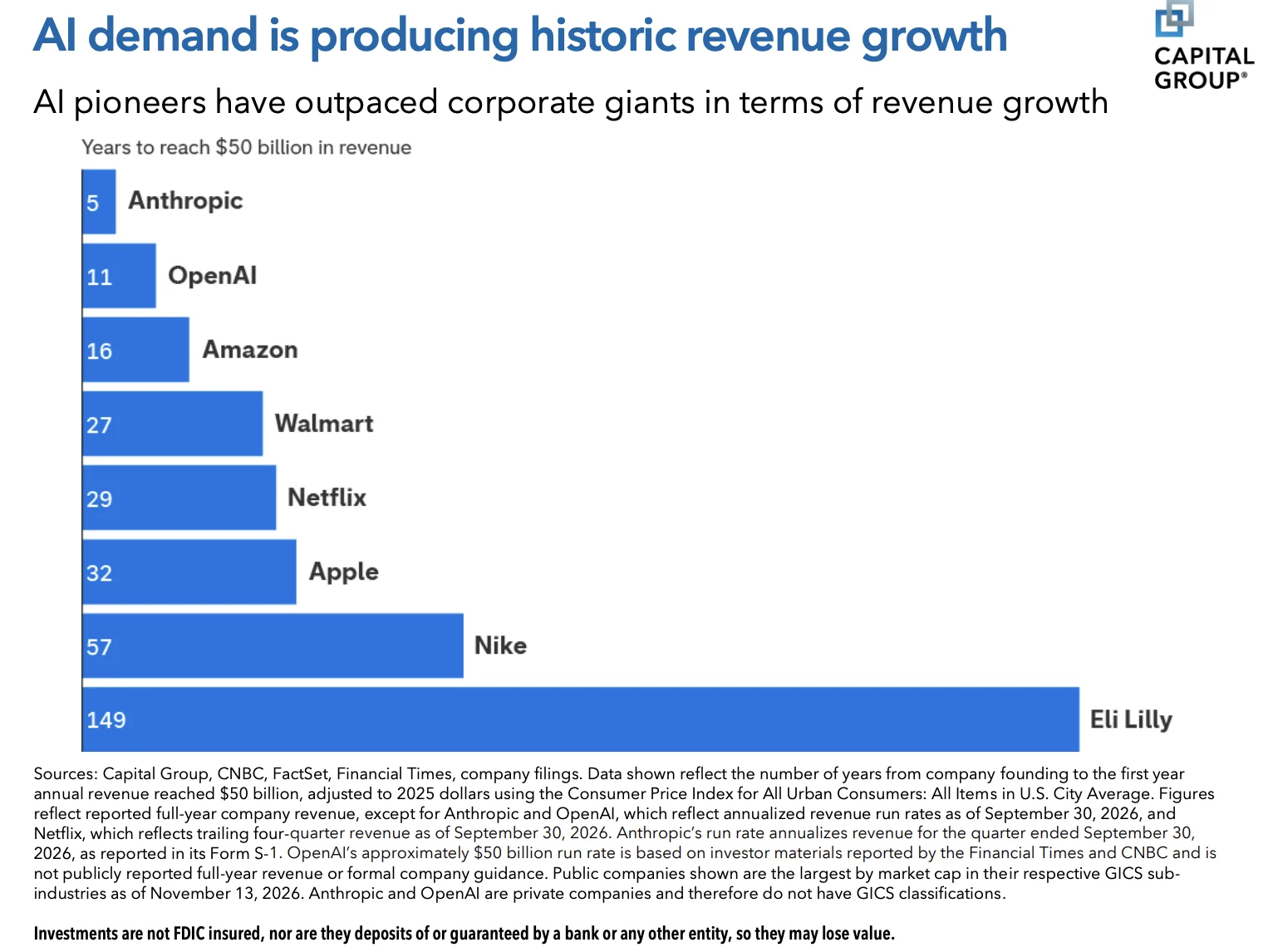
According to Capital Group, Anthropic reached $50 billion in revenue in just five years. Companies like Amazon, Walmart, Apple, and Nike took far longer to reach that level.
That helps explain why the Anthropic IPO was one of the most eagerly awaited listings ever. On Thursday, the company sold roughly 980 million shares at $83 each, above the expected range of $70 to $78. It raised $93.5 billion, topping the $85.7 billion SpaceX raised in June.
Many saw the Anthropic IPO as a proxy for the AI trade and a possible boost for a struggling sector. It didn’t work out that way, at least not yet. After closing at $97.17 on Thursday, the stock ended Friday at $88.91, down 8.5%.
Why Mega IPOs Often Struggle at First
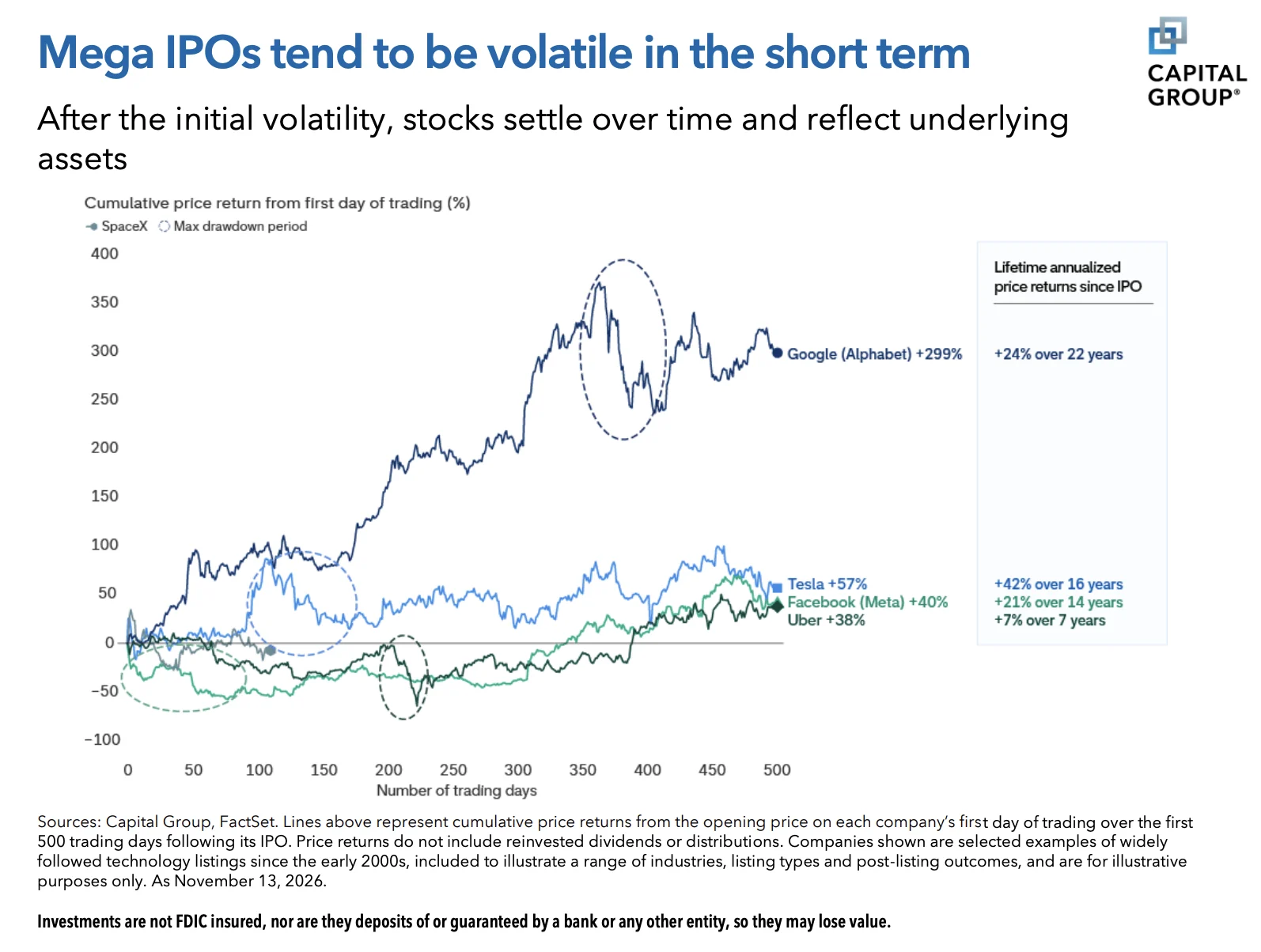
History suggests the Anthropic IPO’s rocky start shouldn’t surprise anyone. Mega IPOs tend to be volatile in the short term. After an initial first-day pop, many struggle in the weeks that follow.
In fact, the 30 largest IPOs on record have underperformed the S&P 500 in the three months after their debut. Over time, though, share prices tend to reflect a company’s earnings potential and underlying assets.
What the Anthropic IPO and This Correction Mean for You
Downturns like this are never fun, but they are normal. Fidelity’s research on market corrections shows drops of 10% to 20% in virtually every decade. Even so, most calendar years still ended with positive returns.
Meanwhile, the fundamental story remains intact:
- Earnings are strong. S&P 500 earnings are on pace to grow more than 30% in 2026 and 16% in 2027.
- Jobs are holding up. Employment growth has strengthened with few layoffs, supporting consumer spending.
- Manufacturing is expanding after many years of decline.
- AI is still a tailwind, helping support manufacturing and broader economic growth.
Fidelity’s Quantitative Market Strategy team also remains constructive for the next 12 months. It sees the economy in a mid-cycle expansion, not on the edge of a recession.
So what should you do? Build a strong cash reserve, stay diversified across sectors, and stick with your long-term plan rather than reacting to short-term swings.
As a Senior Investment Director at US Bank Wealth Management put it, “Sentiment is always the more powerful force in the immediate space, whereas fundamentals tend to win out over time.”
Trusting the One Who Holds It All
Above all, we must not lose our trust in the One who ultimately has all of this under control. Markets rise and fall, but God is sovereign.
“And he put all things under his feet and gave him as head over all things to the church.” (Ephesians 1:22, ESV)
“Do not be anxious about anything, but in everything by prayer and supplication with thanksgiving let your requests be made known to God. And the peace of God, which surpasses all understanding, will guard your hearts and your minds in Christ Jesus.” (Philippians 4:6–7, ESV)
This week we celebrate Thanksgiving. Even in times of volatility and uncertainty, we can be thankful for a Savior who holds the world in His hands.
On behalf of all of us at Life Financial Group, we wish you and your loved ones a blessed and happy Thanksgiving.
Have questions about what this means for your own plan? Reach out to our team, we’re glad to talk it through.
Stay Connected
Have questions or topics you’d like us to cover in a future episode? Email us at contact@thelifegroup.org with “Life in the Markets” in the subject line.
✅ Like, comment, and subscribe on YouTube
🎧 Listen to the audio podcast wherever you get your shows
📘 Pick up a copy of The Good Steward to grow in your financial discipleship
Disclaimer: The topics discussed here are for informational purposes only and do not constitute specific investment advice. Investing involves risks, including potential loss of principal. Past performance does not guarantee future results. Securities and advisory services offered through Geneos Wealth Management, member FINRA/SIPC.