~5 minute read
By Stephen Rohrer, CES™ (Wealth Manager) at Life Financial Group
Originally shared on the Life in the Markets podcast — 8/10/2026
Subscribe on Apple Podcasts or Spotify.
*Note: you will get the most out of this market update by watching the video above*
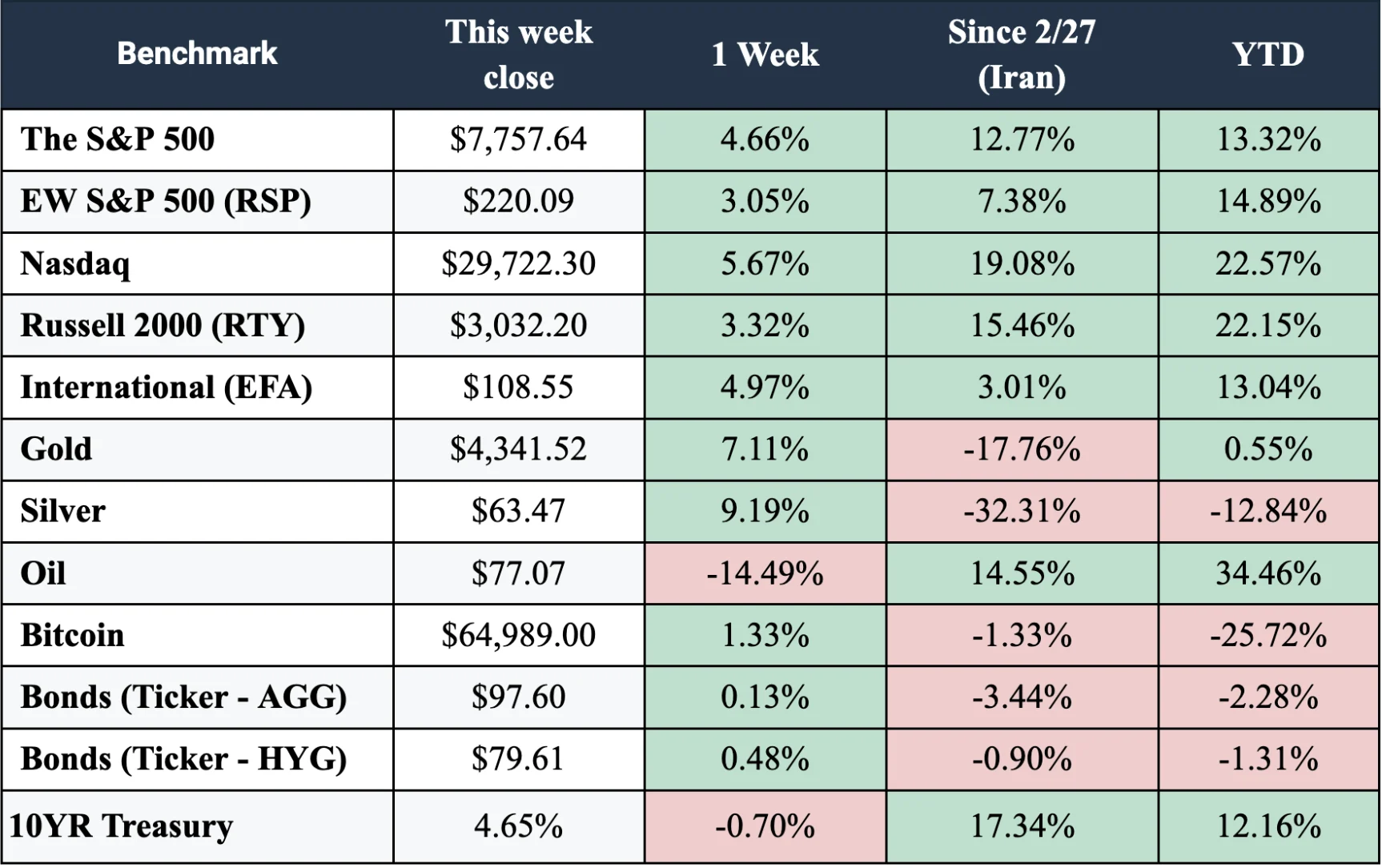
The Market Seems Strong, But There’s More to the Story
This week was a feel-good week in the markets. The S&P 500 reached a new record high, and several areas of the market showed renewed strength. Even SpaceX’s share price recovered a good portion of its recent losses.
The good news is that there are some fundamentally strong reasons for investors to feel encouraged. But, as is often the case with the markets, there is more to the story than simply looking at a new record high.
There Are Some Good Reasons for Optimism
One of the encouraging economic indicators this week was the continued strength in initial jobless claims. The four-week average of initial claims dropped from 203,000 to 199,000. Continuing claims were also approximately 100,000 lower year-over-year.
The earnings picture was encouraging as well.
Across the companies that have reported second-quarter earnings so far, nearly 87% improved their earnings per share (EPS). That is an unusually high percentage and represents the highest rate of improved EPS in roughly five years.
Top-line revenue was also strong. Approximately 77% of companies reporting improved their top-line revenue.
For a quick refresher, EPS measures a company’s earnings after expenses, while top-line revenue reflects the total sales generated by the business. A company can improve EPS by becoming more efficient or reducing costs, even if sales remain relatively flat. Revenue growth, on the other hand, indicates that the company is actually generating more sales.
Seeing improvement in both areas is certainly encouraging.
Not All of the Employment News Was Positive
There was some disappointing employment news in July. Companies laid off more employees than they hired, resulting in a net decline of approximately 23,000 jobs.
That was a significant miss compared with expectations. Economists had anticipated that companies would add approximately 83,000 jobs during the month.
Interestingly, what is negative news for the labor market can sometimes be interpreted as positive news by investors.
Why?
A softer employment picture could reduce the likelihood that the Federal Reserve will need to raise interest rates this year. So while weaker hiring isn’t necessarily good news for workers or the economy, investors may view it favorably if it means less pressure from the Fed.
And this brings us to an important point: not every piece of good market news necessarily tells the whole story.
Potential “Hidden” Negatives
One area worth watching is the way corporate incentives can influence business decisions.
Public companies are under constant pressure to produce strong quarterly results. That pressure can sometimes encourage decisions that improve the numbers in the short term but may not necessarily strengthen the business over the long term.
One example is the use of outsourcing or H-1B workers.
Outsourcing certain functions or hiring employees through H-1B visas can potentially reduce labor costs and improve a company’s profit margins. But there can also be longer-term considerations, particularly when strategically important departments or functions are moved outside the United States.
There has also been increased scrutiny surrounding the H-1B visa program and allegations of fraudulent credentials being used by some applicants.
The H-1B program is intended for foreign workers in specialty occupations that generally require specialized knowledge and a bachelor’s degree or equivalent. It is not simply a program for exceptionally gifted individuals; there are other immigration categories designed for people with extraordinary ability.
Recent reporting has highlighted allegations involving institutions in India producing fraudulent degrees and certifications that could potentially be used in connection with H-1B applications. These allegations have led to additional scrutiny from lawmakers and law enforcement.
Texas Attorney General Ken Paxton, for example, has initiated investigations related to alleged fraudulent use of H-1B visas.
The broader issue is worth considering regardless of where someone stands on immigration policy: companies should be careful not to sacrifice long-term organizational strength simply to improve short-term earnings.
If a company can reduce labor costs, that may look good on the income statement. But investors should also ask whether the decision strengthens the company’s competitive position, protects intellectual property, develops its workforce, and supports the organization’s long-term strategic goals.
In September 2025, President Trump also announced a policy requiring an additional $100,000 payment for businesses seeking to hire workers through the H-1B program, arguing that abuses of the program could discourage Americans from pursuing careers in science and technology and potentially threaten American leadership in those fields.
Regardless of where you land on the policy debate, the underlying investment principle remains important:
Short-term improvements in profitability don’t always translate into long-term improvements in a business.
Investors need to look beyond the next quarterly earnings report and consider the health and strategic strength of the companies they own.
Meta Faces More Scrutiny Over Social Media’s Impact on Children
There was also significant news involving Meta this week.
A lawsuit in New Mexico resulted in a court order requiring Meta to establish a $567 million fund related to harm associated with social media use. The case centered on allegations concerning Meta’s failure to adequately protect children from dangers associated with its platforms.
This is another reminder that businesses can face risks that don’t necessarily show up immediately in quarterly earnings.
Regulatory action, lawsuits, reputational damage, and changing consumer behavior can all affect a company’s long-term prospects.
Again, the lesson is simple: there is more to evaluating a company than looking at its most recent earnings report.
What to Watch This Week
There are several important economic indicators to watch this week.
On Wednesday, the July Consumer Price Index (CPI) numbers will be released. Given the fluctuations in oil prices during July, it will be interesting to see how much of that movement shows up in the inflation data.
Because energy prices can take some time to work their way through the economy, there could potentially be some lingering effects from the decline in oil prices that began in May and June.
We’ll also see additional second-quarter earnings reports throughout the week.
Then, on Friday, we’ll get July retail sales data from the Census Bureau along with the University of Michigan’s latest readings on consumer sentiment and expectations.
Together, these reports should provide additional insight into the health of both consumers and the broader economy.
What Can We Learn From This Week?
When the market has a great week, it can be tempting to want to go all-in on the winners.
And when strong economic indicators accompany those market gains, that temptation can become even stronger.
But this is exactly when discipline matters.
A strong market does not mean every investment is strong. Strong earnings do not mean every company will continue to outperform. And positive economic data doesn’t eliminate the uncertainty that is always present in investing.
This is why diversification and a long-term investment strategy remain so important.
King Solomon gives us a helpful reminder in Ecclesiastes 11:
1 Cast your bread upon the waters,
for you will find it after many days.
2 Give a portion to seven, or even to eight,
for you know not what disaster may happen on earth.
3 If the clouds are full of rain,
they empty themselves on the earth,
and if a tree falls to the south or to the north,
in the place where the tree falls, there it will lie.
4 He who observes the wind will not sow,
and he who regards the clouds will not reap.
5 As you do not know the way the spirit comes to the bones in the womb of a woman with child, so you do not know the work of God who makes everything.
6 In the morning sow your seed, and at evening withhold not your hand, for you do not know which will prosper, this or that, or whether both alike will be good.
Stay Connected
Have questions or topics you’d like us to cover in a future episode? Email us at contact@thelifegroup.org with “Life in the Markets” in the subject line.
✅ Like, comment, and subscribe on YouTube
🎧 Listen to the audio podcast wherever you get your shows
📘 Pick up a copy of The Good Steward to grow in your financial discipleship

Disclaimer: The topics discussed here are for informational purposes only and do not constitute specific investment advice. Investing involves risks, including potential loss of principal. Past performance does not guarantee future results. Securities and advisory services offered through Geneos Wealth Management, member FINRA/SIPC.