~5 minute read
By Stephen Rohrer (Wealth Manager) at Life Financial Group
Originally shared on the Life in the Markets podcast — 9/14/2026
Subscribe on Apple Podcasts or Spotify.
*Note: you will get the most out of this market update by watching the video above*
Market Overview
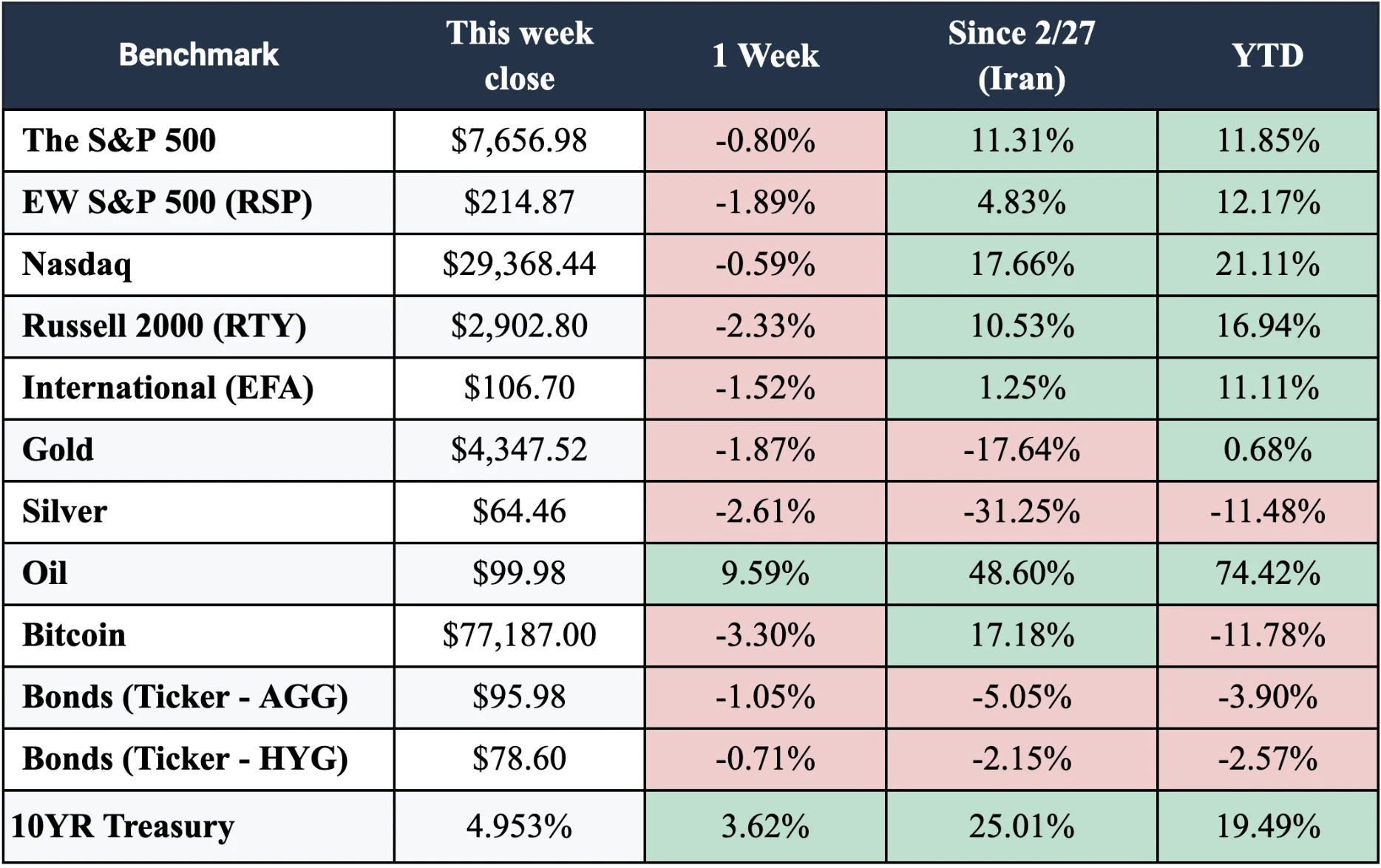
Most of the market spent most of the week retreating from its highs. On Friday, stocks stopped retreating and advanced almost across the board, retaking a good deal of the ground they had lost. They still didn’t quite get back to where they started, and the major indexes ended down for the week.
Inflation: CPI Ran Hot, PPI Cooled
CPI came in with disappointing results. The broad CPI matched expectations at 0.4% month-over-month, but core CPI came in higher than forecast at 0.3% instead of the expected 0.2%. Given the continued Iran war and elevated oil prices, I don’t think that’s shocking.
On the other hand, PPI was on track with expectations, and core PPI came in at just 0.2% against an expected 0.3%. So the producer side offered some relief even as the consumer side ran warm.
The Treasury’s Balancing Act
The Treasury continued exchanging long-term debt for short-term T-bills in a bid to pull down the 10-year Treasury rate, and, hopefully, mortgage rates for prospective homebuyers. The 10-year rose anyway.
For these buybacks to have much effect, the Treasury would likely need to shift to far more short-term debt. That carries its own risk: a heavier concentration of short-term obligations could have grave implications for our overall budget picture down the road.
A Strong Jobs Report, and What It Means for the Fed
The BLS delivered a good jobs report. We added 162,000 jobs instead of the 58,000 expected, and unemployment held at 4.1%.
That’s a good sign for the health of companies and for the market overall. But it was bad news for anyone hoping for rate relief. Strong hiring paired with inflation still running above target raises the odds that the Fed moves the other direction. As it stands, there’s a very good chance the Fed raises rates by roughly 50 basis points.
But Is a Great Jobs Report Great for Families?
Now I want to come back to that jobs report, because while the immediate news is good for the economy, it may not be good for families.
Several outlets have reported on an analysis of BLS data finding that nearly all net job gains since President Trump took office have gone to women. Payroll employment among women is up roughly 765,000 since December 2024, while employment among men has fallen by about 6,000 over the same stretch. August followed the same pattern, with much of the hiring concentrated in industries that employ large numbers of women: restaurants and bars added about 59,000 jobs and local government education added 42,000.
Some have called this great news. Others have suggested the problem is simply that men aren’t trying hard enough. I’m sure there are unmotivated men out there, as there always have been. But I think something more systemic is going on… a shift in hiring patterns that has left men at the back of the line.
Why does this matter? Because without men in good jobs, families don’t get started.
What the Marriage Data Shows
The Institute for Family Studies recently released substantial new data on marriage rates across the United States, including an interactive map. Writing about the findings in The Epoch Times, Walker Larson highlighted a pattern worth sitting with.
Where there are more full-time employed single men relative to single women, marriage rates among young women are meaningfully higher. The ratio of higher-earning men to single women likewise tracks with marriage rates for women in their 30s, though not for women in the 22-to-29 range. And on the other side of the ledger, higher education and income among men correlate with more marriages for men, but chiefly for men in their 30s. For men in their 20s, it matters much less.
Put simply: men’s employment prospects shape whether marriages (and families) happen.
The Order Behind the Numbers
This is the natural order God designed, playing out whether we want to acknowledge it or not. There are always unique circumstances and exceptions. But as a rule, if a man doesn’t have a good job, he is not likely to get married or have children.
“Command these things as well, so that they may be without reproach. But if anyone does not provide for his relatives, and especially for members of his household, he has denied the faith and is worse than an unbeliever.” – 1 Timothy 5:7–8
A strong labor market is a good thing. But a labor market that isn’t putting men in a position to provide is storing up a problem that no quarterly data release will capture.
Big Tech Earnings: Mixed Signals
This week continued the recent pattern of companies beating earnings expectations and getting mixed receptions for it.
Oracle posted a huge earnings report and its share price rose. Adobe also beat expectations, and its share price fell. Investors were largely concerned that Adobe is adding free users without yet converting them into revenue. Beating the number isn’t enough on its own anymore; the market wants to see the path to monetization.
Consumer Sentiment Slides
The University of Michigan released its preliminary consumer sentiment findings. The Consumer Sentiment Index fell sharply from 51.7 to 47.8, well below the 51.0 expected.
That drop coincided with rising inflation expectations. Consumers now expect inflation over the next year to run at 4.6%, up from 4.0%.
Housing Affordability Keeps Getting Worse
Existing home sales fell to 3.98 million annualized from 4.06 million, remaining near 30-year lows. Supply climbed to a 10-year high, even as the median home price rose 1.6% year-over-year.
It’s no surprise the housing market is slowing when affordability keeps deteriorating. The annual income now required to afford the median home has reached $124,000.
What to Expect This Week
The FOMC meets and will decide what to do with the Fed rate. The current expectation is a hike of roughly 50 basis points.
Empire State Manufacturing releases a new survey on Tuesday. It’s expected to pull back to 14.1 from August’s multi-year high of 20.6.
Verse of the Week
“Therefore do not be anxious, saying, ‘What shall we eat?’ or ‘What shall we drink?’ or ‘What shall we wear?’ For the Gentiles seek after all these things, and your heavenly Father knows that you need them all. But seek first the kingdom of God and his righteousness, and all these things will be added to you.” – Matthew 6:31–33
Sources:
- Women account for almost all net U.S. job gains since Trump took office — Just the News
- If You Want to Get Married, Here’s Where You Should Move — The Epoch Times
Have questions about what this means for your own plan? Reach out to our team, we’re glad to talk it through.
Stay Connected
Have questions or topics you’d like us to cover in a future episode? Email us at contact@thelifegroup.org with “Life in the Markets” in the subject line.
✅ Like, comment, and subscribe on YouTube
🎧 Listen to the audio podcast wherever you get your shows
📘 Pick up a copy of The Good Steward to grow in your financial discipleship

Disclaimer: The topics discussed here are for informational purposes only and do not constitute specific investment advice. Investing involves risks, including potential loss of principal. Past performance does not guarantee future results. Securities and advisory services offered through Geneos Wealth Management, member FINRA/SIPC.