~5 minute read
By Stephen Rohrer (Wealth Manager) at Life Financial Group
Originally shared on the Life in the Markets podcast — 7/13/2026
Subscribe on Apple Podcasts or Spotify.
*Note: you will get the most out of this market update by watching the video above*
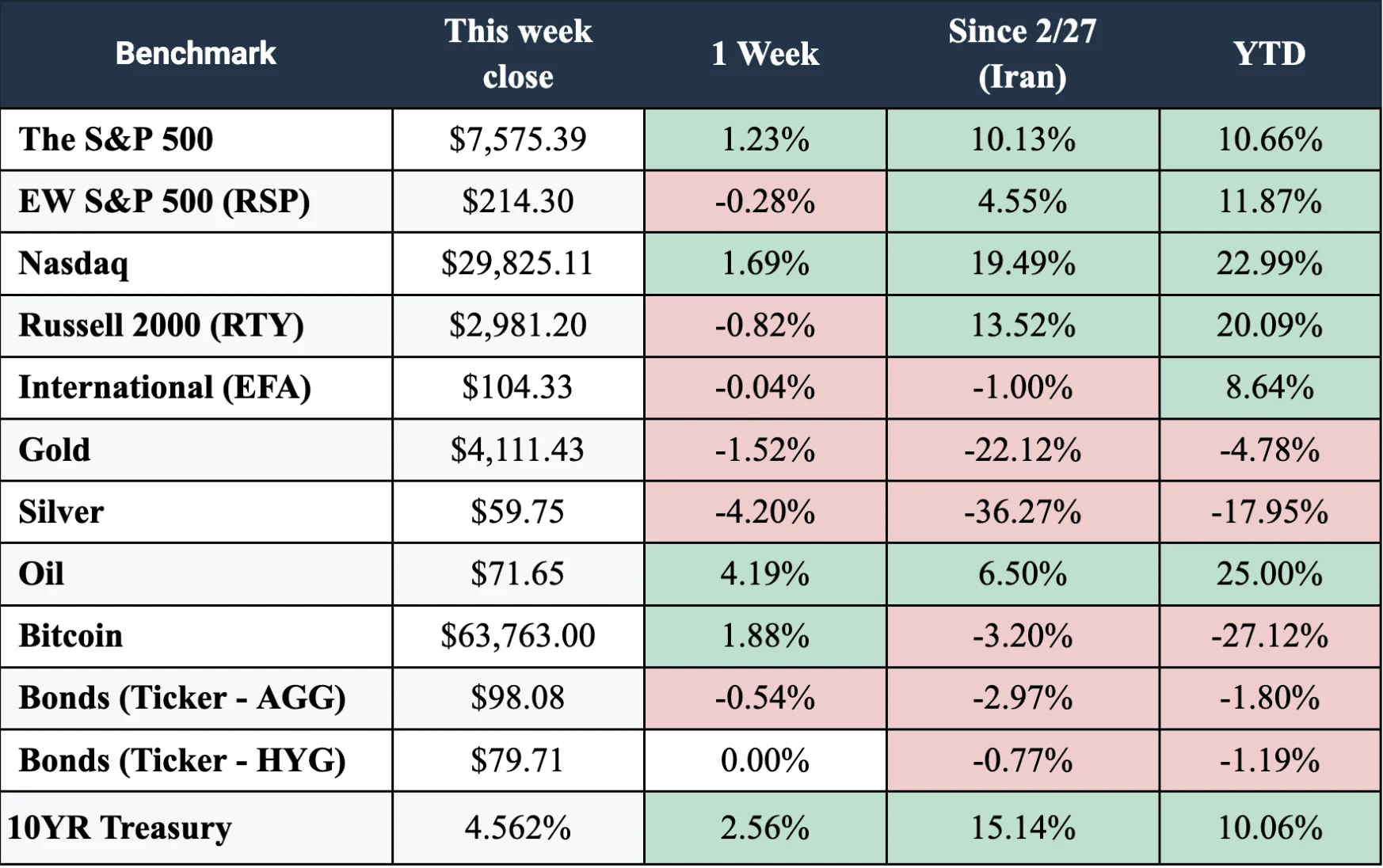
Despite a brief dip in the middle of last week, U.S. stocks finished slightly higher overall. The S&P 500 gained 1.23%, while the Nasdaq climbed 1.69%. Smaller companies lagged slightly, with the Russell 2000 finishing modestly lower, and the equal-weight S&P 500 slipped just 0.28% for the week.
While those weekly numbers may seem mixed, they highlight a much bigger story that has been developing throughout 2026: market strength is spreading beyond the Magnificent 7.
A Healthier Market Beneath the Surface
The equal-weight S&P 500 is now up 11.87% year-to-date, compared to 10.66% for the traditional capitalization-weighted S&P 500.
That may not sound significant at first, but it tells an important story.
The cap-weighted S&P 500 gives much greater influence to its largest companies. Today, the Magnificent 7 account for roughly one-third of the cap-weighted index. Because of that concentration, weakness in just a handful of mega-cap technology stocks can weigh heavily on the index’s overall performance.
In fact, the Magnificent 7 have been largely flat (or even negative) for much of 2026. Microsoft alone was down more than 20% during the first half of the year. Meanwhile, the other 493 companies in the S&P 500 have generated the majority of the index’s gains.
That’s an encouraging development.
Rather than relying on a few technology giants, market gains are becoming more broadly distributed across sectors and companies. Historically, broader participation has been a healthier foundation for long-term market advances than gains driven by only a handful of stocks.
Commodities: Oil Climbs While Precious Metals Slip
Gold and silver both declined again this week, while oil rose roughly 4% to more than $70 per barrel.
The increase in oil prices was driven largely by renewed geopolitical tensions after the ceasefire with Iran broke down and disruptions resumed in the Strait of Hormuz. Even so, investors appear to be looking past the day-to-day headlines surrounding the conflict, with markets remaining relatively resilient.
Diesel prices have also been climbing, although for a different reason. Ukraine’s recent strikes on Russian diesel refineries have reduced supply, and because Russia produces more than 11% of the world’s diesel, those disruptions have meaningful global effects.
Labor Market Remains Stable
The labor market continued to show signs of stability.
Initial jobless claims declined from 217,000 to 215,000, indicating that layoffs remain relatively low.
However, another labor statistic deserves attention. The number of people participating in the workforce fell by approximately 720,000 in June. While some of that decline reflects the ongoing retirement of Baby Boomers, a long-anticipated demographic trend, it remains an important figure to monitor as labor force participation continues to evolve.
Housing Affordability Remains a Challenge
The housing market continues to move slowly.
While a healthy housing market benefits from consistent turnover and steady sales activity, today’s slower pace could eventually help bring home prices closer to levels that are attainable for younger families.
Affordability remains one of the biggest obstacles facing first-time homebuyers. Homeownership has long been one of the primary ways families build wealth, establish financial stability, and create an environment where raising children becomes more attainable.
For now, however, prices have yet to adjust meaningfully. Existing home prices remain up 1.8% year over year, even as sales activity has cooled.
What to Watch This Week
Two developments will likely receive the most attention in the coming week.
First, investors will receive the latest Consumer Price Index (CPI) report, providing another look at inflation. Although oil prices have moderated over the past month, energy costs typically take time to filter through the broader economy, meaning any relief may not appear immediately in the data.
Second, newly appointed Federal Reserve Chair Kevin Warsh will testify before Congress. Investors will be listening closely for any comments regarding inflation, interest rates, and the economy. However, he will likely avoid offering significant forward guidance and instead emphasize the Federal Reserve’s independence from political influence.
Final Thoughts
This week’s biggest takeaway wasn’t simply that the S&P 500 finished higher.
The more important story is that market participation continues to broaden. As more companies contribute to overall market gains, investors become less dependent on a small group of mega-cap technology stocks to drive returns.
While economic uncertainty and geopolitical risks remain, broader market leadership is generally a constructive sign for long-term investors.
Verse of the week.
As we have been reminded this year with the broadening of the market, stay diversified in the long run. King Solomon reminds us of this with our verse of the week:
“Invest in seven ventures, yes, in eight; you do not know what disaster may come upon the land.” – Eccl. 11:2.
Stay Connected
Have questions or topics you’d like us to cover in a future episode? Email us at contact@thelifegroup.org with “Life in the Markets” in the subject line.
✅ Like, comment, and subscribe on YouTube
🎧 Listen to the audio podcast wherever you get your shows
📘 Pick up a copy of The Good Steward to grow in your financial discipleship
Disclaimer: The topics discussed here are for informational purposes only and do not constitute specific investment advice. Investing involves risks, including potential loss of principal. Past performance does not guarantee future results. Securities and advisory services offered through Geneos Wealth Management, member FINRA/SIPC.