~5 minute read
By Stephen Rohrer (Wealth Manager) at Life Financial Group
Originally shared on the Life in the Markets podcast — 6/29/2026
Subscribe on Apple Podcasts or Spotify.
*Note: you will get the most out of this market update by watching the video above*
Market Update for June 29, 2026
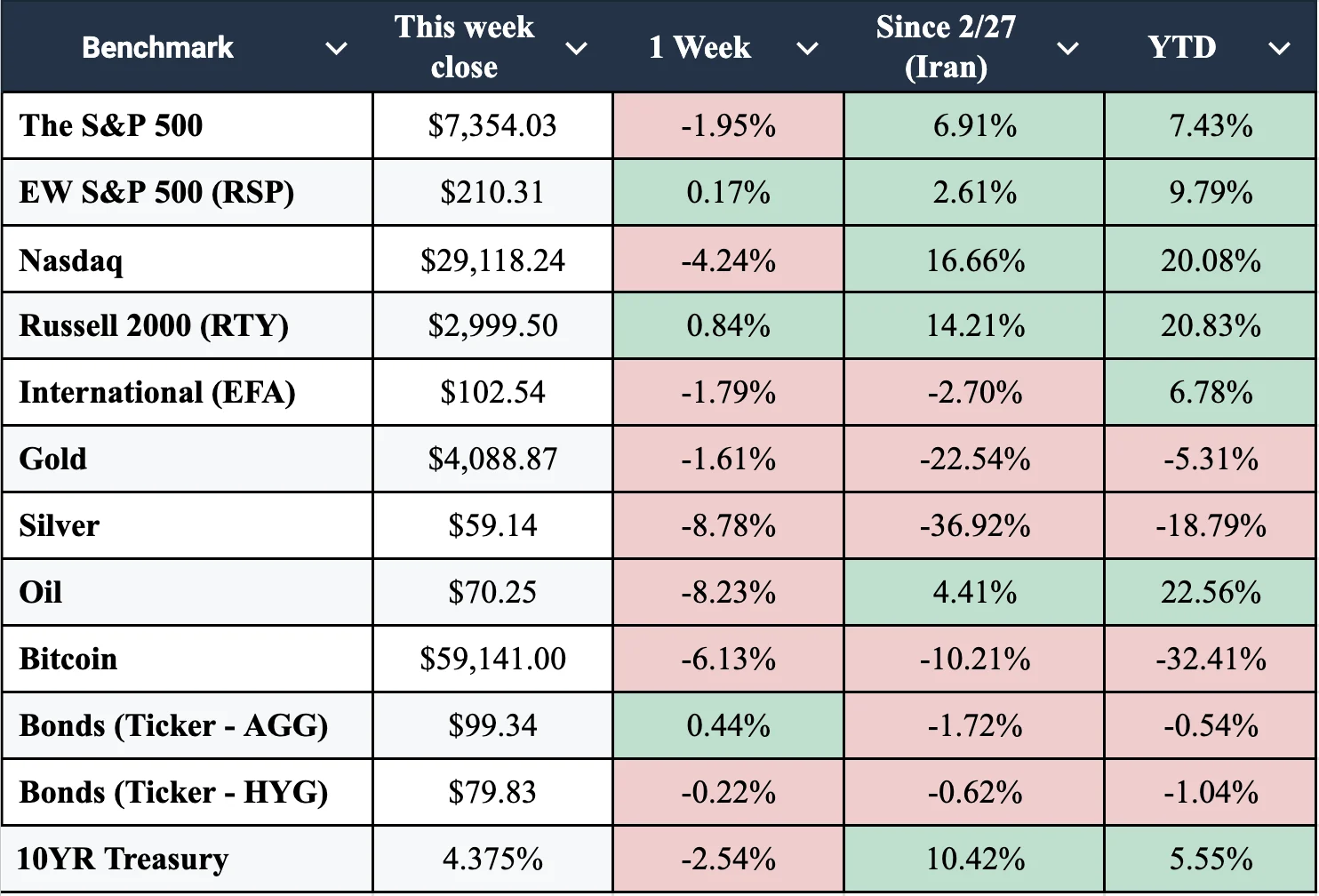
This past week, the S&P 500 and Nasdaq declined by 1.95% and 4.24%, respectively. For the Nasdaq, it was the second-worst week of the year. Meanwhile, the Dow Jones Industrial Average, with its blue-chip companies, managed to eke out a third consecutive positive week, finishing up 0.59%.
The more interesting story, however, was the equal-weight S&P 500. While the traditional cap-weighted S&P 500 fell nearly 2%, the equal-weight version actually gained 0.17%, a difference of more than two percentage points.
Given the outsized influence of the largest companies in the cap-weighted S&P 500, where the top ten companies still account for nearly 40% of the entire index, this is actually an encouraging sign.
Cap Weight vs. Equal Weight
You may be wondering, what exactly is the difference between a cap-weighted index and an equal-weighted index?
“Cap” is short for market capitalization, which is simply the total value of a company’s publicly traded shares. In a cap-weighted index, companies with larger market capitalizations have a greater influence on the index’s performance.
There is good logic behind this approach. If you’re trying to measure the overall economy, companies that employ more people, pay more taxes, and create more goods and services naturally represent a larger portion of economic activity. Giving those companies greater weight can make sense.
An equal-weighted index takes a different approach by giving every company the same influence on the index, regardless of size.
Why It Matters
The challenge is that a company’s stock price can rise for reasons beyond the value it currently adds to the economy.
Often, investors bid prices higher because they expect future growth. Other times, stocks simply continue rising because they’re already rising. Human nature plays a role…when others appear to be getting rich, we don’t want to miss out.
Increasingly, however, this process has become mechanical through the rise of index investing.
If you own a fund that tracks a cap-weighted index, nearly 40 cents of every dollar invested in the S&P 500 is effectively allocated to just ten companies. For an individual investor, that may still be a perfectly reasonable portfolio. But when millions of investors are doing exactly the same thing, it creates the potential for the market as a whole to become overly concentrated in a very small number of companies.
That’s why this week’s performance was encouraging.
When the equal-weight S&P 500 outperforms the cap-weighted version, it suggests that market gains are broadening beyond just the largest companies. A healthier market isn’t dependent on only a handful of stocks carrying the entire index.
As a wise farmer knows, you don’t plant every field with only one crop.
A Lesson from South Korea
We received another reminder of this principle from South Korea this week.
The country’s primary stock index, the KOSPI, is even more concentrated than the S&P 500. Two companies (Samsung and SK Hynix) make up roughly 45% of the entire index.
On Tuesday, the KOSPI experienced a sharp 10% correction. Because Samsung and SK Hynix are two of the world’s leading semiconductor manufacturers supplying the AI industry, the decline rippled through technology stocks around the globe.
None of this suggests these companies are poorly run. By all appearances, they remain excellent businesses benefiting from tremendous demand for semiconductors and artificial intelligence infrastructure.
But even outstanding companies can only climb so high, so quickly, before gravity begins to assert itself. Markets occasionally need to pause and recalibrate.
Oil and the Middle East
Oil prices continued to decline this week, falling below $70 per barrel, as markets increasingly assume tensions with Iran will stabilize.
Although additional strikes occurred over the weekend, and President Trump made several headline-grabbing social media posts regarding Iran, markets appear to be growing less reactive to each new development.
Remembering Alan Greenspan
This week also marked the passing of former Federal Reserve Chairman Alan Greenspan at the age of 100.
Greenspan was one of the most influential figures in modern finance. Appointed by President Ronald Reagan in 1987, he served until 2006, making him the second-longest-serving Fed Chair in history.
One of Greenspan’s defining characteristics was his reluctance to signal future Federal Reserve policy decisions. His successor, Ben Bernanke, shifted toward a strategy known as forward guidance, in which the Fed intentionally communicates its future intentions to financial markets.
We discussed this topic in last week’s episode because newly appointed Fed Chair Kevin Warsh has expressed his desire to move away from forward guidance and return to a more Greenspan-like approach.
With the Federal Reserve now moving back toward some of Greenspan’s philosophy after nearly two decades, his passing feels especially significant.
What Should We Do This Week?
This will be a shortened trading week as our nation celebrates its 250th birthday.
It’s an opportunity to reflect with humility and gratitude for the many blessings God has bestowed upon our country. It’s also fitting to remember the faithful men and women who sacrificed their lives, fortunes, and sacred honor for the truths they believed to be inalienable.
May their example inspire us to do difficult things for the sake of those who come after us.
We should also remember that, humanly speaking, our nation should not exist. There was no obvious path by which thirteen colonies could defeat the greatest military power on earth, much less survive as a united nation and flourish.
Verse of the Week
As we close, Psalm 33 provides a fitting reminder that the destiny of nations ultimately rests not in military strength or economic power, but in the sovereign hand of God.
Psalm 33:8–22
Let all the earth fear the Lord;
let all the inhabitants of the world stand in awe of him!
9 For he spoke, and it came to be;
he commanded, and it stood firm.10 The Lord brings the counsel of the nations to nothing;
he frustrates the plans of the peoples.
11 The counsel of the Lord stands forever,
the plans of his heart to all generations.
12 Blessed is the nation whose God is the Lord,
the people whom he has chosen as his heritage!13 The Lord looks down from heaven;
he sees all the children of man;
14 from where he sits enthroned he looks out
on all the inhabitants of the earth,
15 he who fashions the hearts of them all
and observes all their deeds.
16 The king is not saved by his great army;
a warrior is not delivered by his great strength.
17 The war horse is a false hope for salvation,
and by its great might it cannot rescue.18 Behold, the eye of the Lord is on those who fear him,
on those who hope in his steadfast love,
19 that he may deliver their soul from death
and keep them alive in famine.20 Our soul waits for the Lord;
he is our help and our shield.
21 For our heart is glad in him,
because we trust in his holy name.
22 Let your steadfast love, O Lord, be upon us,
even as we hope in you.
Stay Connected
Have questions or topics you’d like us to cover in a future episode? Email us at contact@thelifegroup.org with “Life in the Markets” in the subject line.
✅ Like, comment, and subscribe on YouTube
🎧 Listen to the audio podcast wherever you get your shows
📘 Pick up a copy of The Good Steward to grow in your financial discipleship
Disclaimer: The topics discussed here are for informational purposes only and do not constitute specific investment advice. Investing involves risks, including potential loss of principal. Past performance does not guarantee future results. Securities and advisory services offered through Geneos Wealth Management, member FINRA/SIPC.