~5 minute read
By Stephen Rohrer (Wealth Manager) at Life Financial Group
Originally shared on the Life in the Markets podcast — 9/21/2026
Subscribe on Apple Podcasts or Spotify.
*Note: you will get the most out of this market update by watching the video above*
Market Overview
What Do Yields, Rates, and Bonds Mean for You?
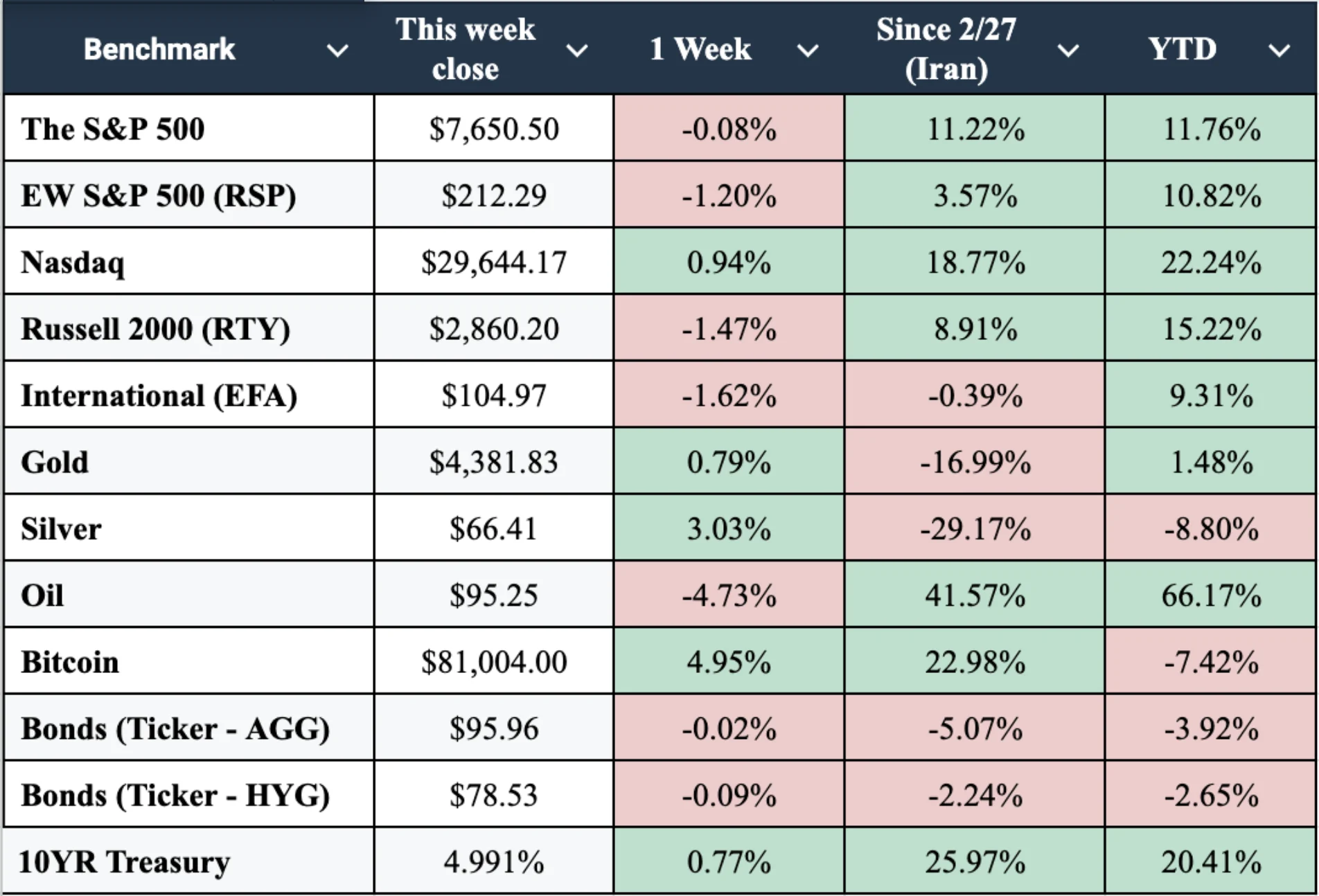
This week the market digested a confirmed Fed rate increase, though it was no surprise to anyone. The S&P dipped during the week, recovered most of it, and finished nearly flat. The equal weight index lost 1.2%, while the Nasdaq was up almost 1% by Friday’s close. The Russell 2000 and international both gave back about a point and a half. Gold climbed 79 bps, silver rose 3%, and oil slipped to $95 on news that Saudi Arabia is restarting its East-West pipeline after damage.
The 10-year Treasury briefly crossed 5% for the first time since 2007 and ended the week at 4.991%.
The Bigger Story Is What Didn’t Happen
Despite the Fed hike, bond yields stayed almost flat. That is worth pausing on, because it looked very different a few years ago.
In 2022, the year began with the Fed funds rate at 0 to 0.25%. Over the next 16 months, the Fed marched it all the way up to 5.5%, with several 75 bps hikes stacked back to back.
Here is the part most people miss. The question is not how many basis points the rate is moving. It is how much that change represents as a percentage of the current rate. A 0.25% hike sounds routine. But a 0.25% hike on a 0.25% rate, which is exactly what happened in March of 2022, is a 100% increase.
A 100% increase in a single month creates a wild swing in yields. And if you look at the full move, going from 0.25% to 5.5% is a 2100% increase. Since bond prices and yields move in opposite directions, it is no surprise the bond market had terrible years in 2022 and 2023.
Now compare that to today. A 0.25% hike on a 3.75% rate is only a 6% change. That is not going to throw yields into a spin. Part of the calm this week was that the hike was expected and already priced in. But the other part is simply that it is not much of a change on a percentage basis.
Fed rate changes do ordinarily affect yields and the market. They just should not have the dramatic effect they had during the 2022 to 2023 hiking cycle.

What This Means for You
Rates and yields are important economic signals and they certainly affect your investing. But as our President Tim Russell likes to say, bonds should never be the most exciting part of your portfolio. With yields now adjusting off a more central position, bonds should go back to being the steadier, less exciting piece of the puzzle. That is exactly what they are there for.
A Note on AI and Regulation
Calls for government regulation of AI development have been loud lately. On September 12, the CEOs of Anthropic and OpenAI both publicly called for slowing the pace of AI capability development, pointing to risks from increasingly autonomous agent systems.
This week Mark Zuckerberg pushed back. His argument, in short, was that labs already carry real liability if their models cause harm, so the incentive to be careful is built in. He noted that Meta delayed shipping a product for months over safety and security work without asking anyone else to go first, and said that committing most of their compute to serving people rather than racing toward recursive self-improvement is one of the best safety decisions a lab can make. He believes the key is maintaining the right balance of power.
That is an excellent point. Why would a company need the government to pump the brakes on its own car? There is a long history of industries asking for regulation, and the reason is not always noble. Regulation adds cost and difficulty. If you are already the 800-pound gorilla, you can absorb that. If you are the little guy trying to compete, it can break you. Rockefeller had to box out competitors himself. Today a large corporation can have the government do it with tax dollars, all “for the safety and common good of all.”
If these labs see a problem with the trajectory of their own models, then change the trajectory. No one, not even the government, will know how to do that better than they will.
Quick Economic Check-In
Housing: Buyers were dealt another blow, with mortgage rates jumping to land around 7%. As we have been covering, the home price to income ratio is already extremely high by historical standards. Add a stiff mortgage rate and it is a rough combination, especially for first-time buyers.
Employment: Initial jobless claims fell to 196,000 from 206,000, coming in 11,000 below expectations. The four-week average dropped to 203,000 and continuing claims fell to 1.73 million from 1.77 million. Still a solid picture.
Manufacturing: The Philly Fed Manufacturing Index eased from August but held at a solid 37.8, which is 10 points above its six-month average. Inventories dropped 12.5% and delivery times jumped from 4.2% in August to 26.5%. Keep in mind that number simply reflects how many survey respondents feel deliveries are taking longer versus shorter. The Empire State index fell more steeply, from 20.6 to 7.6 against an expected 15. That is sentiment more than hard data, but it suggests hesitancy given the ongoing Iran conflict and elevated oil prices. It lines up with the University of Michigan consumer sentiment reading on September 11, which slipped from 51.7 to 47.8. What people feel and what people actually do with their money are often two different things, but it is still a useful pulse check.
What to Look for This Week
A fairly quiet calendar. More earnings are coming from consumer giants like Costco, which should tell us something about how people are spending. August new home sales arrive Thursday.
Verse of the Week
“The plans of the diligent lead surely to abundance, but everyone who is hasty comes only to poverty.” Proverbs 21:5
Have questions about what this means for your own plan? Reach out to our team, we’re glad to talk it through.
Stay Connected
Have questions or topics you’d like us to cover in a future episode? Email us at contact@thelifegroup.org with “Life in the Markets” in the subject line.
✅ Like, comment, and subscribe on YouTube
🎧 Listen to the audio podcast wherever you get your shows
📘 Pick up a copy of The Good Steward to grow in your financial discipleship
Disclaimer: The topics discussed here are for informational purposes only and do not constitute specific investment advice. Investing involves risks, including potential loss of principal. Past performance does not guarantee future results. Securities and advisory services offered through Geneos Wealth Management, member FINRA/SIPC.