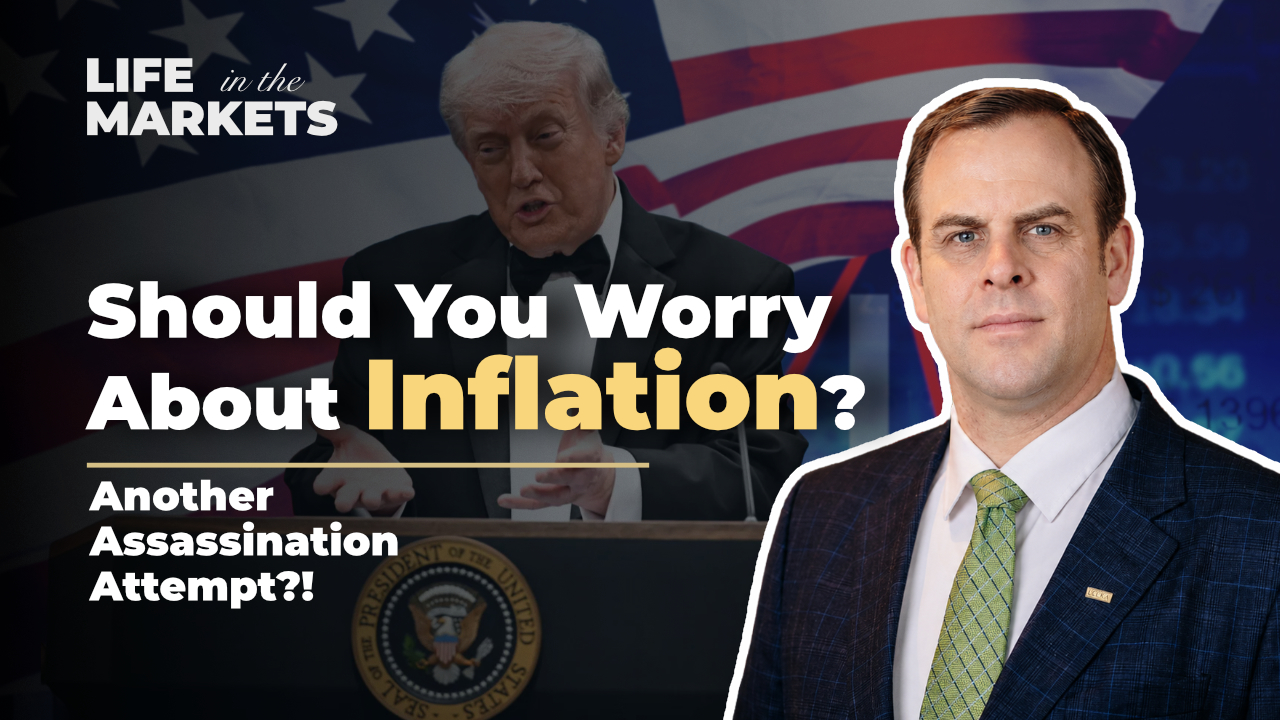
By Tim Russell, President & Wealth Manager at Life Financial Group
Originally shared on the Life in the Markets podcast — 07/07/2025
Subscribe on Apple Podcasts or Spotify.
The First Six Months of 2025 Are in the Books
If you were in a coma for the last six months and just woke up, you might be stunned at where we are today. We’ve had a new president who’s aggressively pushed through a slew of executive orders and directives, shifting the political landscape dramatically—and, predictably, drawing major pushback.
Politically, the biggest surprise:
A major tax reform victory for the administration. We’ll dive deeper into that shortly when we unpack the new “Big Beautiful Bill”—a massive piece of legislation with plenty of personal finance implications.
Interestingly, this bill was signed into law on July 4—an intentional bit of symbolism that wasn’t lost on Wall Street.
Beyond Politics: Trade Wars, Middle East Tensions & Inflation Twists
We’ve also seen:
- Escalating conflict in the Middle East
- Heated tariff tensions and global trade uncertainty
- Concerns over former President Trump’s aggressive tariff policies
We’ve discussed this before, but it’s worth repeating: I don’t like tariffs. They distort markets and are inflationary in nature.
However…
As a negotiating tool, tariffs can be highly effective. Fast-forward six months, and we now have:
- A trade deal with China
- Trade deals with Europe
- Improved trade agreements with many other countries
Honestly, who had that on their 2025 bingo card?
And here’s the kicker: Despite tariffs’ inflationary nature, we’re now seeing lower inflation:
- Eggs are cheaper
- Gas is cheaper
- Prices on many goods have fallen
Yes, even I’m surprised. I still believe tariffs will have long-term inflationary effects—but short-term? Using them as a negotiating tactic has been helpful.
The Market’s Wild Ride: A Crash and a Roaring Recovery
We’ve also witnessed one of the sharpest market drops—followed by a stunning recovery.
It feels a lot like COVID’s market crash and bounce-back in 2020.
Earlier this year, we saw sharp market losses due to scary headlines, but within an incredibly short time, we recovered all of those losses—and now we’re hitting all-time highs.
This rebound happened even faster than the COVID recovery.
It’s almost hard to believe we were drowning in fear just three months ago.
5 Market Lessons from 2025 (So Far)
Looking back, here are five critical takeaways from the first half of 2025:
1. Fear & Uncertainty Are Normal
Uncertainty is part of investing. You’ll never have enough clarity or confidence to invest without some level of discomfort.
Don’t wait for fear to vanish. Invest in spite of it.
2. Conventional Wisdom Doesn’t Always Work
Case in point: After the Iran bombing, everyone (including me) expected oil prices to skyrocket.
Instead? Prices fell—due to negotiations and cooler heads prevailing.
3. Stick to Diversification & Risk Plans
In turbulent markets, resist the urge to panic-sell or time the market.
Let your diversified portfolio and risk plan do their job.
4. News-Driven Events Resolve Quickly
Markets generally return to their primary trend within months after major news shocks.
If fundamentals haven’t changed, the market usually resumes its previous direction.
5. Political Bias Skews Market Perception
Political views heavily influence how we feel about markets and the economy.
We must strive to remain objective—even when we have strong personal leanings.
The “Big Beautiful Bill”
Now, let’s unpack the massive tax bill President Trump signed on July 4:
1. Tax Cuts Extended
The Trump-era tax cuts—set to expire in 2026—are now extended through 2029.
Planning Tip:
This gives investors—especially those with large IRAs—more time for Roth conversions at today’s lower tax rates.
2. Social Security Tax Relief
Trump didn’t eliminate Social Security taxes entirely, but:
- New $6,000 deduction for singles ($12,000 for couples) to offset Social Security taxes.
- Applies to those with under $75,000 (single) or $150,000 (married) in modified adjusted gross income (MAGI).
3. SALT Deduction Increased
The State & Local Tax (SALT) deduction cap rises from $10,000 to $40,000 (phased out for high earners). Phase-out starts at $250K (single) and $500K (married).
4. No Tax on Tips (Up to $25,000)
Applies to certain industries like hospitality and food service (details still emerging).
5. Limited Overtime Tax Exemption
Only the overtime premium portion is exempt from tax, not base wages. Income cap: $150K (single) and $300K (married).
6. Car Loan Interest Deduction
Limited deduction for car loan interest—but only on American-made vehicles, and capped at $1,000. Caution: I generally advise against car loans, even with this deduction.
7. “Trump Account” for Newborns
For babies born 2025–2029:
- $1,000 government contribution + optional $5,000 parental contribution annually.
- Usable for college, trade school, or home purchase after age 18.
- Invested in the market (likely S&P 500 index fund).
8. Qualified Business Income Deduction Increased
Pass-through business owners (LLCs & S-Corps) can now deduct 23% of income (up from 20%).
9. 100% Bonus Depreciation
Businesses can fully deduct certain investments in the year they’re made—encouraging domestic investment, job creation, and reshoring.
Final Thoughts
These tax changes may be significant in your situation, and some details remain unclear. If you have questions, feel free to reach out via our website: TheLifeGroup.org.
Before we wrap up, I’ll leave you with this passage from Matthew 25:
“For to everyone who has will more be given, and he will have an abundance. But from the one who has not, even what he has will be taken away.”
This isn’t about politics or taxes—it’s about stewardship. God calls us to wisely manage everything He entrusts to us—our finances, relationships, and time. Be faithful where you are. Don’t let fear or headlines distract you from that calling.
Disclaimer: The topics discussed here are for informational purposes only and do not constitute specific investment advice. Investing involves risks, including potential loss of principal. Past performance does not guarantee future results. Securities and advisory services offered through Genios Wealth Management, member FINRA/SIPC.