~5 minute read
By Stephen Rohrer (Wealth Manager) at Life Financial Group
Originally shared on the Life in the Markets podcast — 7/20/2026
Subscribe on Apple Podcasts or Spotify.
*Note: you will get the most out of this market update by watching the video above*
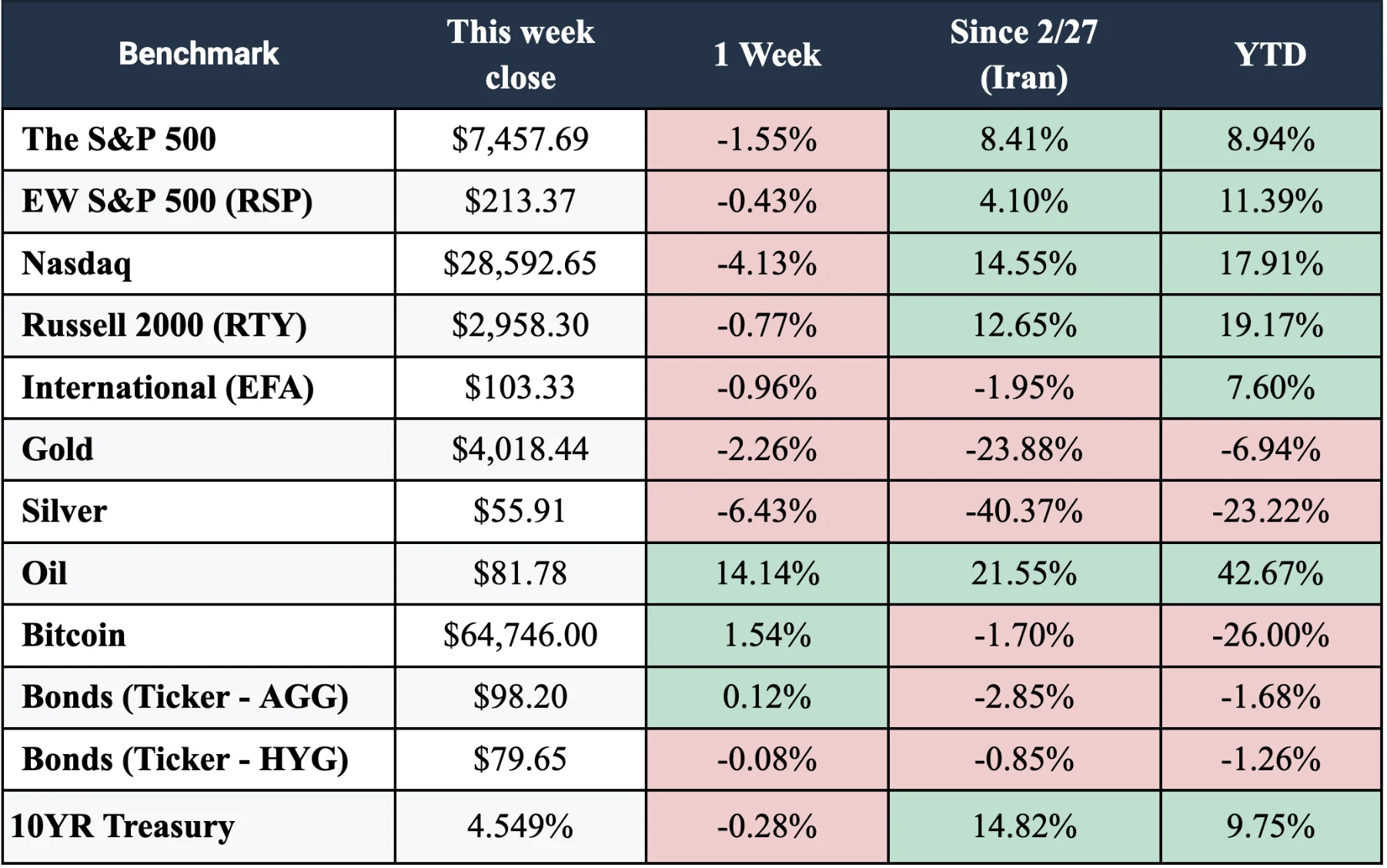
Last week was a down week across almost all major market indexes. Gold and silver also declined, with silver falling more than 6%. Oil, however, rose about 14% as continued disruptions in the Strait of Hormuz pushed prices higher. In the bond market, the AGG was up slightly, while the corporate bond index dipped modestly. The 10-year Treasury declined 0.28%.
While the market was down a bit, the broader economy actually delivered encouraging news. Initial jobless claims came in lower than expected at 208,000 compared to the forecast of 218,000. Manufacturing and retail reports also showed steady progress.
The fundamentals of the economy continue to look healthy, and those fundamentals are far more important than the normal week-to-week fluctuations in the stock market.
Is There Gambling in the Market?
Speaking of market fluctuations, David Bahnsen of The Bahnsen Group and others recently noted that nearly 30% of all options being traded now have zero-day expiration.
Let me translate the financial jargon.
An option is a contract that gives someone the right to buy or sell a security, such as a stock, at a predetermined price by a specified future date. When used carefully by experienced professionals, options can serve as valuable tools for hedging risk.
However, they can also fuel a gambling mentality and become extremely risky, especially for inexperienced investors.
Trading platforms like Robinhood have made options trading remarkably accessible, but accessibility does not equal simplicity. Options are complicated financial instruments that can create significant losses in a very short amount of time.
In 2021, CBS News detailed the tragic story of a 20-year-old Robinhood user who took his own life after his account incorrectly appeared to show a $750,000 loss from options trading, despite having invested only a fraction of that amount. The incident highlighted both the complexity and potential dangers of these financial products.
Now consider what zero-day expiration (0DTE) actually means.
It means the option expires at the end of the very same trading day. In essence, it becomes a wager on where the market will move over the next several hours.
When you combine the fact that nearly 30% of options trading now consists of these ultra-short-term trades with the reality that average daily options volume has surged to roughly 6.8 billion contracts, nearly double historical averages, it becomes clear that this points to something much larger than simple investing.
The Culture of Gambling
The larger issue is our culture’s growing embrace of gambling.
Countless lives are being damaged by gambling addiction.
If you’ve watched major sporting events recently, you’ve probably noticed that many of the commercials promote online sports betting. That’s no longer unique to one league or one event, as sports gambling advertisements have become nearly unavoidable.
When I traveled from Pennsylvania to North Carolina over the Fourth of July, it seemed like there was a casino at almost every highway exit.
While the rapid expansion of casinos is significant, I believe the greater danger is online gambling.
Online gambling has done for gambling addiction what the internet did for pornography addiction. It has made it private, immediate, and accessible almost anywhere, at any time. What once required intentional effort is now available with a few taps on a smartphone.
With that context, it becomes much easier to understand why we’ve seen an unprecedented surge in options trading—particularly zero-day expiration trading that provides an almost instant rush.
Sadly, I would imagine that many of you know someone who struggles with gambling addiction. It is a heartbreaking and increasingly common problem.
What Should Christians Think about Gambling?
As Christians, how should we think about gambling?
When gambling was legalized in Pennsylvania several years ago, it sparked a healthy discussion about whether gambling is permissible for believers.
Historically, Christians in the United States, and throughout much of church history, have generally discouraged gambling. In many places, gambling businesses were even prohibited by law.
Some rightly pointed out that gambling is never explicitly forbidden in Scripture. That observation is true. However, while the Bible may not specifically prohibit gambling, it repeatedly warns against the love of money, greed, and the desire to gain wealth quickly.
As 1 Timothy 6:10 reminds us:
“For the love of money is a root of all kinds of evil.”
Gambling often thrives on that very temptation.
Verse of the Week
Proverbs 22:28 tells us:
“Do not move the ancient landmark that your fathers have set.”
The principle is straightforward. When previous generations have established wise boundaries, we should be slow and cautious before removing them. They likely didn’t establish those boundaries simply to spoil our fun.
Historically, society placed significant limits on gambling because its destructive effects were evident.
Unlike businesses that create products or provide meaningful services, gambling largely transfers wealth from many people to a few while profiting from repeated losses. Beyond a questionable entertainment value, it contributes little that genuinely enriches families, communities, or society.
As Christians, we are called to be faithful stewards, not people seeking quick riches or the next adrenaline rush. Investing should be rooted in wisdom, patience, and long-term ownership, not speculation that resembles gambling.
The goal of investing is to participate in the growth of productive businesses over time, not to place bets on what the market might do over the next few hours.
When our approach to money reflects biblical stewardship rather than the pursuit of excitement or easy gain, we’re far more likely to experience both financial wisdom and lasting contentment.
Stay Connected
Have questions or topics you’d like us to cover in a future episode? Email us at contact@thelifegroup.org with “Life in the Markets” in the subject line.
✅ Like, comment, and subscribe on YouTube
🎧 Listen to the audio podcast wherever you get your shows
📘 Pick up a copy of The Good Steward to grow in your financial discipleship
Disclaimer: The topics discussed here are for informational purposes only and do not constitute specific investment advice. Investing involves risks, including potential loss of principal. Past performance does not guarantee future results. Securities and advisory services offered through Geneos Wealth Management, member FINRA/SIPC.