~5 minute read
By Tim Russell, CFP®, CKA®, (President & Wealth Manager) and Stephen Rohrer (Wealth Manager) at Life Financial Group
Originally shared on the Life in the Markets podcast — 6/22/2026
Subscribe on Apple Podcasts or Spotify.
*Note: you will get the most out of this market update by watching the video above*
Market Update for June 22, 2026
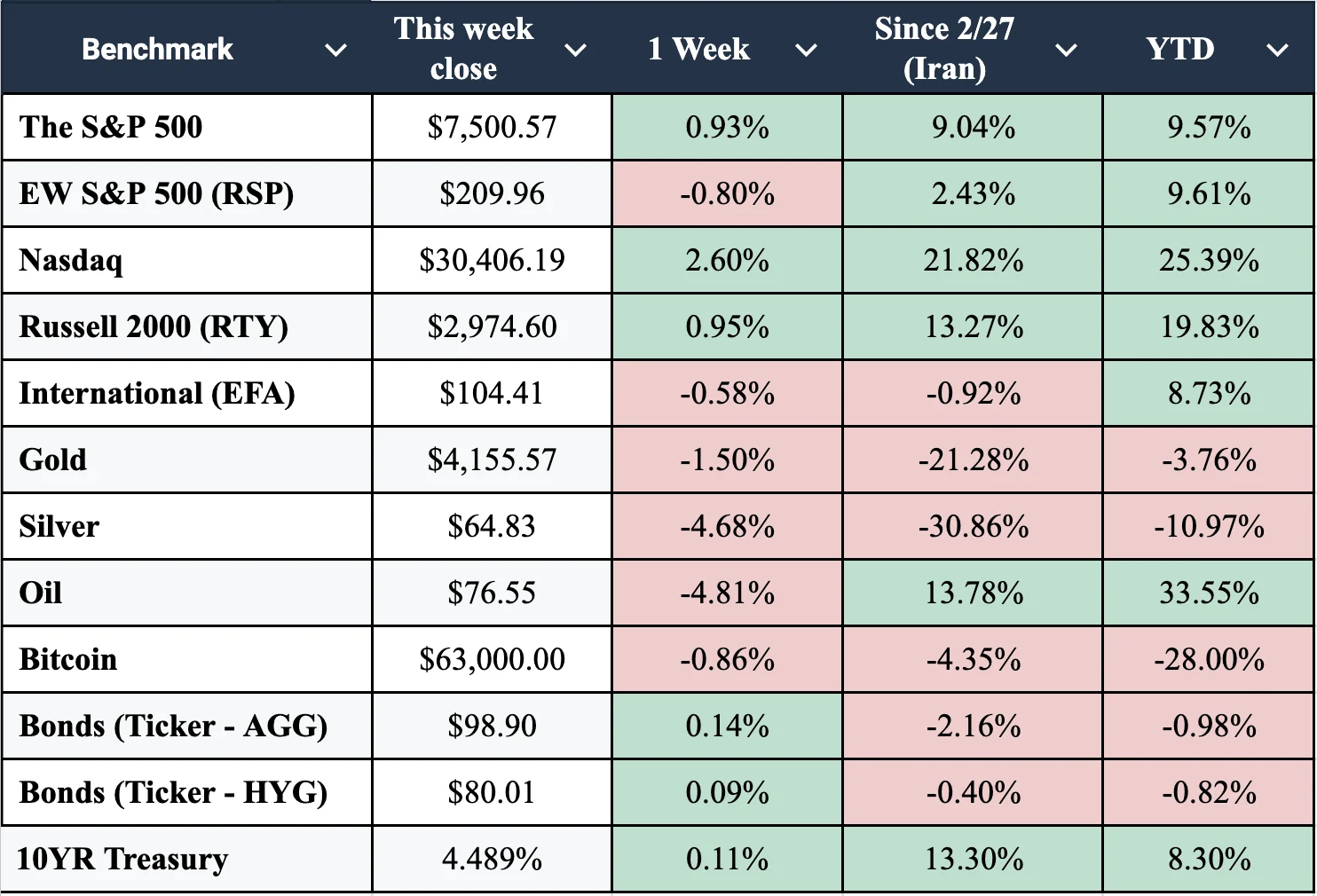
A Short Trading Week, But No Shortage of Market News
Although markets were closed on Thursday in observance of Juneteenth, investors still had plenty of news to digest during the shortened trading week.
Two developments stood out: escalating tensions in the Middle East and the first Federal Reserve meeting led by new Fed Chair Kevin Warsh.
Rising Tensions in the Middle East
The fragile peace agreement between the United States and Iran faced an early test over the weekend. On Saturday, Iran announced the closure of the Strait of Hormuz, one of the world’s most strategically important shipping routes.
The Strait of Hormuz serves as a critical passageway for global energy markets, with a significant portion of the world’s oil and natural gas shipments traveling through the region. Any disruption to traffic through the strait has the potential to impact global energy prices and create additional market volatility.
President Trump responded by indicating that the United States would be willing to secure the waterway and potentially impose tolls on ships passing through the strait as compensation for providing security in the region.
As always, investors should remember that geopolitical events can create short-term market volatility, but maintaining a long-term perspective remains critical.
Kevin Warsh’s First Federal Reserve Meeting
The second major story of the week was the first Federal Reserve meeting and press conference led by newly appointed Fed Chair Kevin Warsh.
Unlike many recent Fed Chairs, Warsh’s comments were concise and direct. His messaging suggested a generally hawkish stance, emphasizing the Federal Reserve’s commitment to bringing inflation under control through monetary policy and interest rate decisions.
His approach marked a noticeable departure from the communication style investors have grown accustomed to over the past several years.
What Does “Hawkish” or “Dovish” Mean?
Financial commentators frequently describe Federal Reserve officials as either “hawkish” or “dovish,” but these terms can be confusing for many investors.
A hawkish Federal Reserve is primarily focused on controlling inflation. Hawks are generally more willing to raise interest rates or keep rates elevated in order to slow economic activity and reduce inflationary pressures.
A dovish Federal Reserve, on the other hand, places greater emphasis on supporting economic growth and employment. Doves are generally more inclined to lower interest rates or maintain accommodative policies to stimulate economic activity.
It’s important to note that policymakers are not permanently hawks or doves. The same individual may take a hawkish stance during periods of elevated inflation and a dovish stance when economic growth is slowing. Their position often depends on what they believe the economy needs most at a particular point in time.
A Different Approach to Federal Reserve Communication
Perhaps the most notable takeaway from Warsh’s first meeting was his criticism of what economists call forward guidance.
Forward guidance refers to the Federal Reserve’s practice of signaling future policy intentions to markets. Since the financial crisis of 2008, particularly during former Fed Chair Ben Bernanke’s tenure, the Fed has often communicated its expected path for future interest rate decisions months in advance.
The Benefits of Forward Guidance
Supporters of forward guidance point to several advantages:
- Markets generally dislike uncertainty.
- Investors can adjust expectations and “price in” anticipated policy changes.
- Some of the Fed’s objectives can be achieved through communication alone, before any actual policy changes occur.
When market participants know what the Fed intends to do, they can begin adjusting investment decisions, borrowing costs, and economic expectations ahead of time.
The Drawbacks of Forward Guidance
However, forward guidance is not without its critics.
One concern is that it can create a false sense of certainty. While the Fed may outline plans several months into the future, those plans are based on current economic conditions. The reality is that economies, markets, and geopolitical events can change rapidly.
As economists often say, ceteris paribus, “all things being equal”, is a useful assumption in theory but rarely reflects reality.
Another challenge is that the Fed may feel pressured to follow through on previously communicated plans, even when changing economic conditions might justify a different course of action. Deviating from earlier guidance can sometimes create greater market disruption than if no guidance had been provided in the first place.
Warsh’s View
Chair Warsh appears skeptical of the modern Fed’s reliance on forward guidance. He has suggested that “talking about policy as a means of creating policy” has become excessive and may produce unintended or counterproductive consequences.
SpaceX Continues to Climb
One final observation about the markets. Last week Space X stock continued to climb as investors jumped into the stock. We have no opinion on what the price of Space X should be or will be. That being said, it is still too early to trust that the price of the stock is settled in. You see, after a highly publicized IPO like this, it’s common for the price to bounce around a bit while the public is still trying to get into the stock. I would expect that the price will settle into a more normal pattern once the majority of the public that wants shares has purchased shares. At that point, I would expect sellers to come in and push the price lower, creating a potentially more affordable entry point.
Verse of the Week
Proverbs 16:9 “ The heart of man plans his way, but the LORD establishes his steps.” (ESV)
Stay Connected
Have questions or topics you’d like us to cover in a future episode? Email us at contact@thelifegroup.org with “Life in the Markets” in the subject line.
✅ Like, comment, and subscribe on YouTube
🎧 Listen to the audio podcast wherever you get your shows
📘 Pick up a copy of The Good Steward to grow in your financial discipleship
Disclaimer: The topics discussed here are for informational purposes only and do not constitute specific investment advice. Investing involves risks, including potential loss of principal. Past performance does not guarantee future results. Securities and advisory services offered through Geneos Wealth Management, member FINRA/SIPC.