Written by Stephen Rohrer, Wealth Manager
Fear.
What a frightful word.
Immediately upon hearing the word a variety of sensations appear within us. Often the fight or flight instinct flashes first. After that God-given primal response comes a more intellectual realization — a distinctly unpleasant realization that we might be in danger. Something else can inflict damage on us and we may not be able to prevent it.
Our rational side begins to explore our options beyond fight or flight. Should we roll over and surrender? Can we make friends with the threat? What if we try negotiating? Maybe if we just ignore it and bury our head in the sand it will pass by and leave us alone.
In any case, our thoughts are now consumed with the object causing us to fear. The Fearful Object takes over our mind and thus our actions as well.
So, is fear bad or just very bad?
That is usually how we think of it. As President Franklin Roosevelt said, “we have nothing to fear, but fear itself.” That sounds quite empowering.
But is it true?
Perhaps it is not as simple as that.
God tells us a different story about fear.
“The fear of the Lord is the beginning of wisdom.” (Prov. 9:10), and “The fear of the Lord is the beginning of knowledge; fools despise wisdom and instruction.” (Prov. 1:7).
As King David—who faced down many powerful dangers—tells us, “Oh, fear the Lord, you his saints, for those who fear him have no lack.” (Ps. 34:9).
But the Apostle Paul also says, “for God gave us a spirit not of fear, but of power and love and self-control.” (2 Tim. 2:17). And Moses commanded the people of God going into the Promised Land, “Be strong and courageous. Do not fear or be in dread of them, for it is the Lord your God who goes with you. He will not leave nor forsake you.” (Deut. 31:6).
It becomes clear that fear itself is not the thing to fear. Rather it is God, the Maker of heaven and earth, whom we should fear.
G. K. Chesterton summed it up beautifully: “We fear men so much, because we fear God so little. One fear cures another. When man’s terror scares you, turn your thoughts to the wrath of God.”
The Object of our Fear will control us – the question is not If, but Who do we fear most?
Jesus tells us forcefully in Luke 12:5 “But I will warn you whom to fear: fear him who, after he has killed, has authority to cast in hell. Yes, I tell you, fear him!”
When we fear God properly, we, as Christian stewards, need fear nothing else.
However, this is easier said than done. Fear is always lurking and even our fear of God is not always properly ordered. Let us examine some of the ways that fear manifests in disordered ways.
Fear comes primarily in two ways – internal and external.
Internal Fear: Jesus gives us an example of how internal fear can cause stewards to fail in their duties. Knowing that God gave us everything can be frightening. As the bad steward in Matthew 25 expressed, “‘Master, I knew you to be a hard man, reaping where you did not sow, and gathering where you scattered no seed, so I was afraid” (emphasis added). When we grasp the awesome power of God, we can shrink into self-deprecation. Often the thought of messing something up paralyzes us. Our fear whispers to us that the safest path is not to get on a path at all. If we just don’t do anything, we can’t make a mistake. The problem is that our focus is turned inward. This turns a fear of God into a fear of our own abilities. God knows how many talents to give us. He knows what we can handle and what we cannot. Self-deprecation is not trusting God to give us what we can handle. But as Matthew 25:15 says, “to one, he gave five talents, to another two, to another one, to each according to his ability.” Look to God. Proper fear of God means that we trust in His sovereign will and wisdom. He gives us what we are capable of stewarding.
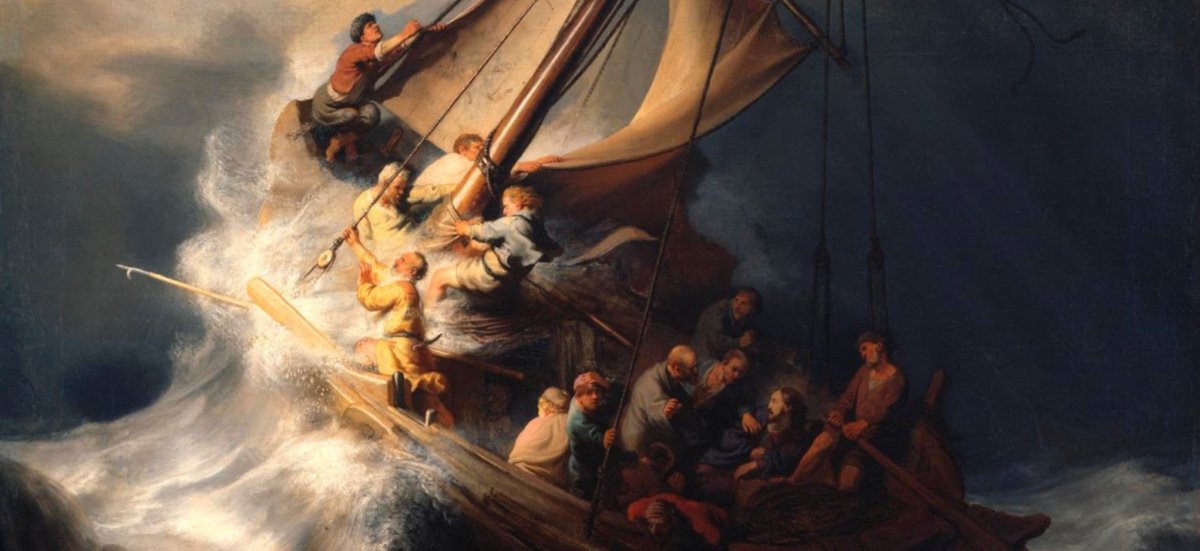
External Fear: Internal fears come from looking inward, but external fears take control when our eyes are fixed on the world around us. While we should be wise and watchful (Proverbs 22:3 “The prudent sees danger and hides himself, but the simple go on and suffer for it”), we must not focus on the waves. Practically, this means we should not spend all our time watching “fear-peddlers” (i.e. News). Yes, the “days are evil,” but our duty is to “make the best use of time” (Eph. 5:16). Regardless of the storm around us, our duty is to keep our eyes on Christ and take another step forward into the waves.
“22 Immediately he made the disciples get into the boat and go before him to the other side, while he dismissed the crowds. 23 And after he had dismissed the crowds, he went up on the mountain by himself to pray. When evening came, he was there alone, 24 but the boat by this time was a long way from the land, beaten by the waves, for the wind was against them. 25 And in the fourth watch of the night he came to them, walking on the sea. 26 But when the disciples saw him walking on the sea, they were terrified, and said, “It is a ghost!” and they cried out in fear. 27 But immediately Jesus spoke to them, saying, “Take heart; it is I. Do not be afraid.”
28 And Peter answered him, “Lord, if it is you, command me to come to you on the water.” 29 He said, “Come.” So Peter got out of the boat and walked on the water and came to Jesus. 30 But when he saw the wind, he was afraid, and beginning to sink he cried out, “Lord, save me.” 31 Jesus immediately reached out his hand and took hold of him, saying to him, “O you of little faith, why did you doubt?” 32 And when they got into the boat, the wind ceased. 33 And those in the boat worshiped him, saying, “Truly you are the Son of God.” (Matt. 14:22-33)
When we fear God truly, we understand that He is all-powerful. He controls the wind and the waves. In Matt. 25, the bad steward was afraid of what might happen, but the master does not accept that excuse.
The bad steward was ruled by both internal and external fear, but not the right fear. We should not be ruled by the wrong fears. Instead, we should fear the Lord of Hosts, the Maker of Heaven and Earth, and King of Kings. This fear leaves us with no excuse. Instead, it drives us to “be strong and courageous” because “it is the Lord who goes before you. He will be with you; he will not leave you or forsake you. Do not fear or be dismayed.” (Deut. 31:7b and 8)
We must be self-aware (guarding against our own weaknesses) and watchful of danger, but we must carry out the stewardship roles that He has given us.
Let proper fear inspire us to bold and shrewd action.
All Scripture quotations are from the English Standard Version (ESV) unless otherwise noted.