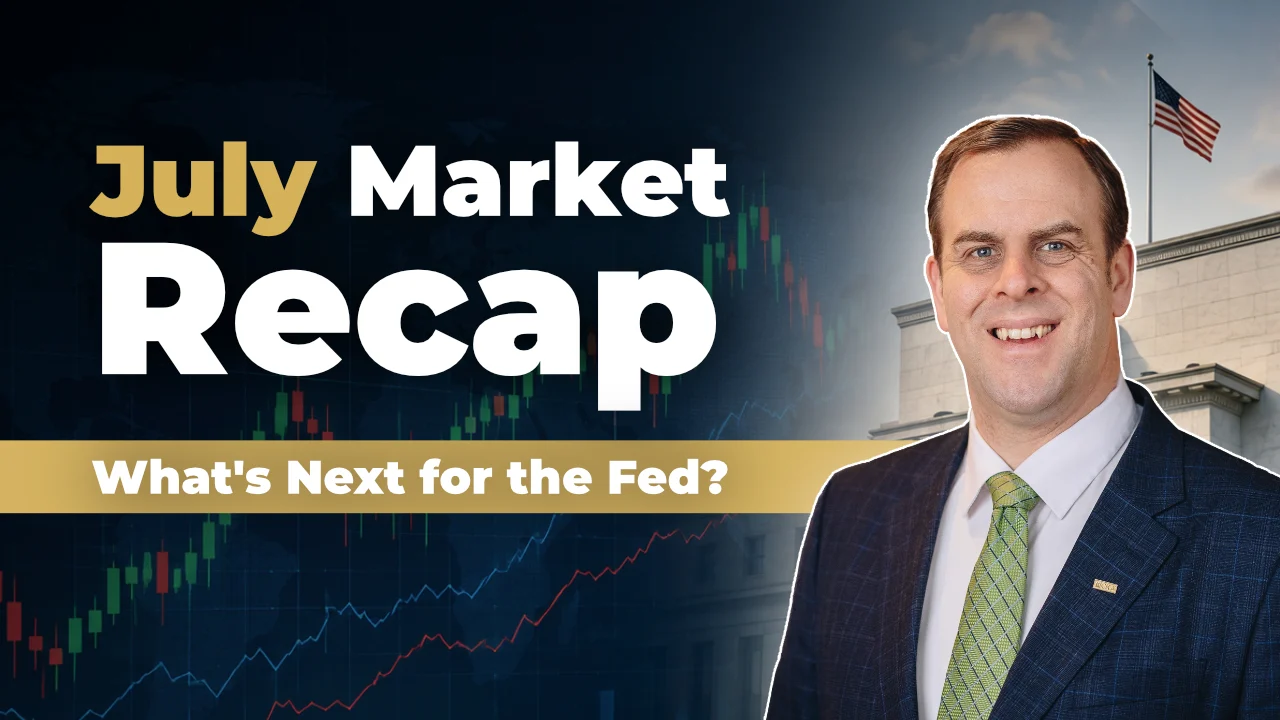
By Tim Russell, CFP®, President & Wealth Manager at Life Financial Group
Originally shared on the Life in the Markets podcast — 11/3/2025
Subscribe on Apple Podcasts or Spotify.
*Note: you will get the most out of this market update by watching the video above*
November 3, 2025 – Choppy Waters Everywhere
It’s been another roller coaster week on Wall Street. The markets continue to churn as investors digest the latest moves from the Federal Reserve, a continuing government shutdown, and a steady stream of corporate earnings. But above all else, one topic continues to dominate the headlines—and investor sentiment: Artificial Intelligence (AI).
Let’s talk about what AI means for investors, what’s driving this surge of excitement, and how we should think about it—both financially and theologically.
Market Recap: Choppy Waters Everywhere
The week ended with mixed performance across major indices.
- S&P 500: Down about 0.2%
- NASDAQ: Up 0.5%
- Russell 2000: Down 1.7%
Commodities were just as volatile. Gold dropped 1%, silver rose 1%, and oil slipped nearly 1.5%. Bitcoin fell roughly 6%, continuing its recent downward trend.
Bonds had a rough week too. The 10-year Treasury yield dipped below 4% midweek but rebounded to nearly 4.8%—a significant move that signals renewed concerns about economic risk. As I often remind investors: the bond market usually sees trouble before the stock market does.
The Fed, the Shutdown, and Uncertainty Ahead
The big story this week was the Federal Reserve’s decision to cut rates by 0.25%. That was widely expected. What caught investors off guard was the Fed’s tone—essentially saying, “Don’t count on another rate cut in December.”
A week ago, traders priced in a 98% probability of another rate cut. Today, that probability has dropped to 69%. That’s a huge swing in market expectations—and it sent stocks wobbling.
Complicating things further, we’re entering the fourth week of a historic government shutdown. This means we’re not getting the usual flow of economic data, forcing investors to lean more heavily on corporate earnings reports for clues about the health of the economy.
Earnings: Big Tech Keeps Winning
And those earnings? They’ve been strong—especially among the tech giants.
Apple, Amazon, Alphabet (Google), Microsoft, and others reported impressive profits. These are the companies driving the AI revolution, and they’re pouring billions into machine learning, cloud computing, and generative AI tools.
Even consumer data looked decent. Visa and Mastercard reported continued spending strength, suggesting the consumer hasn’t hit a wall yet—though rising credit card balances could signal that households are stretching to keep up with inflation.
Speaking of inflation, the latest figure came in at 3%—a little higher than ideal but lower than feared. All things considered, the economic picture remains murky but manageable.
The Great Divergence: Big Tech Soars, Small Caps Struggle
Here’s something striking: while the overall market is near record highs, the number of companies hitting new 52-week lows is the highest since March.
That means the market’s strength is being carried by a handful of large tech names—mainly those tied to AI. Smaller and mid-sized companies, on the other hand, are struggling. It’s a tale of two markets.
This leads us to the main story: AI fever.
The AI Boom: Bubble or Breakthrough?
AI is the defining theme of this market cycle. The world’s largest companies are betting that artificial intelligence will transform industries, revolutionize productivity, and reshape entire economies.
And they may be right. But we need to separate hype from reality.
There are AI skeptics—those who warn that this is a bubble waiting to burst, much like the dot-com boom of the early 2000s. And while I wouldn’t go that far, there are “bubblish” elements in today’s market. Valuations are stretched, expectations are sky-high, and enthusiasm is spilling into every corner of the tech world.
The mantra among investors is simple: “Be a disruptor, or be disrupted.”
That’s why the Apples, Amazons, and Alphabets of the world are racing to stay ahead. Nobody wants to be left behind.
A Theological Perspective on AI
Now, let’s shift gears for a moment.
From a theological standpoint, many Christians view AI with suspicion—even fear. Some see it as a sign of mankind overstepping its bounds, as if it could dethrone humanity or signal the end times.
But I believe AI itself is not evil—nor divine. It’s neutral. It’s a tool.
Like any technology, it can be used for great good or great harm depending on who wields it.
Here’s the key: AI can never replace humanity.
Why? Because humans are created in the image of God (Genesis 1:27). We are unique in all creation. No machine—no matter how advanced—can replicate that divine imprint.
AI may enhance human work, amplify productivity, and expand knowledge, but it cannot surpass or replace the essence of who we are.
That’s why I’m not an AI doomsayer. I don’t believe AI will render humanity obsolete. It will, however, change how we work, not whether we work.
The Real Challenge: Powering the AI Revolution
Here’s the overlooked side of this story: energy.
AI models are incredibly power-hungry. The computing demand is outpacing our ability to generate electricity efficiently. If this continues unchecked, we could face two outcomes over the next five years:
- Higher energy prices — as power demand outstrips supply.
- Less reliable electricity — potential brownouts or grid instability, especially in high-demand regions.
Unless chipmakers can dramatically improve energy efficiency—or we expand our power generation capacity—the AI boom could hit a physical, not financial, limit.
That’s why the next big innovation opportunity might not be AI itself, but AI efficiency—making smarter chips that require less power.
The Bottom Line
AI is not going away. It’s shaping the next generation of business and investment opportunities. But investors need to stay grounded.
- Don’t buy into every headline. Not every AI-related stock will win.
- Remember your theology. Only humans bear the image of God, not algorithms.
- Watch the infrastructure. The AI revolution depends as much on power and hardware as on software and data.
I’m optimistic about the future of AI—but cautiously so. There’s tremendous promise, but also a pressing need for wisdom. Let’s invest with discernment, not fear.
Because no matter how advanced our technology becomes, nothing we create will ever surpass the Creator, or the people made in His image.
Stay Connected
Have questions or topics you’d like us to cover in a future episode? Email us at contact@thelifegroup.org with “Life in the Markets” in the subject line.
✅ Like, comment, and subscribe on YouTube
🎧 Listen to the audio podcast wherever you get your shows
📘 Pick up a copy of The Good Steward to grow in your financial discipleship
Disclaimer: The topics discussed here are for informational purposes only and do not constitute specific investment advice. Investing involves risks, including potential loss of principal. Past performance does not guarantee future results. Securities and advisory services offered through Geneos Wealth Management, member FINRA/SIPC.